

Complaint 1: “These Darts Feel Different From My Last Set”
What Players Mean
Players rarely describe technical issues. Instead, they say:
-
“Balance feels off”
-
“They fly differently”
-
“Weight feels wrong”
-
“Grip feels slightly different”
These are not emotional reactions. They are micro-sensory feedback.
Real Manufacturing Causes
-
Weight Tolerance Too Wide
-
If tolerance is ±0.2g per dart but sets are not matched internally, total set variation can be noticeable.
-
Professionals can detect even 0.1g imbalance.
-
-
Center of Gravity Shift
-
Small changes in internal bore depth or grip cutting depth can move balance points.
-
Even coating thickness affects this slightly.
-
-
Material Density Variation
-
Switching tungsten batches without recalibration affects machining behavior.
-
Factory-Level Prevention
-
Match darts at set level, not only individual level.
-
Record balance point data.
-
Lock CNC programs for repeat production.
-
Maintain batch traceability for material sourcing.
Consistency is not a promise. It is documentation.
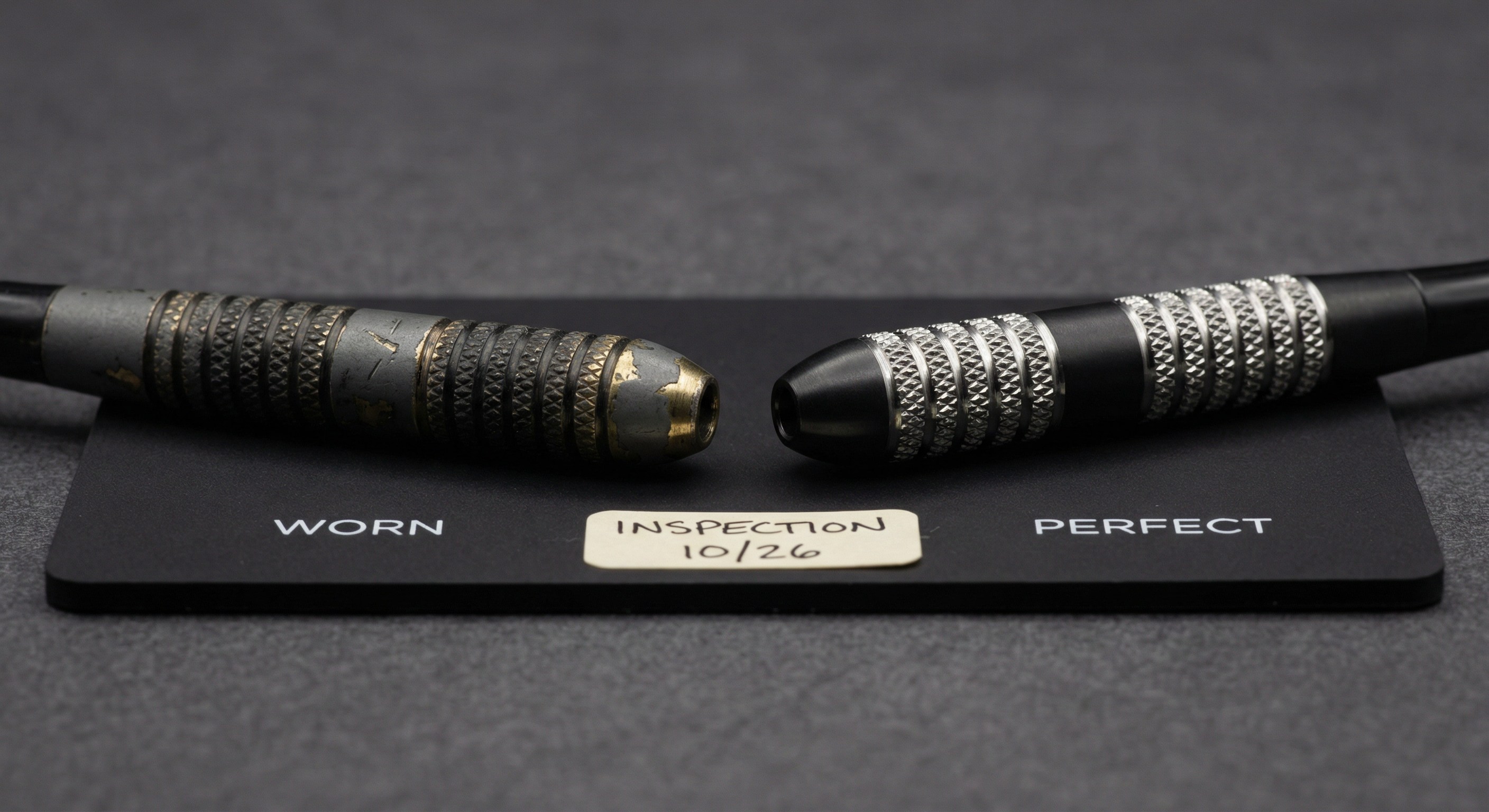
Complaint 2: “The Grip Wears Out Too Fast”
What Players Experience
After 1–2 weeks:
-
Grip becomes smoother.
-
Fingers slip during release.
-
Control decreases.
Manufacturing Causes
-
Grip Geometry Too Shallow
-
Decorative grip patterns look good but lack functional depth.
-
Insufficient cutting depth reduces durability.
-
-
Over-Polishing After Machining
-
Aggressive finishing smooths functional edges.
-
-
Coating Overfill
-
Thick coatings partially fill grip grooves.
-
Early wear exposes inconsistent surface.
-
-
Tool Wear in CNC Cutting
-
Dull tools reduce sharpness consistency.
-
Prevention Measures
-
Standardize minimum grip depth.
-
Monitor CNC tool wear cycles.
-
Test friction levels before mass production.
-
Perform post-coating grip inspection.
Grip durability is engineered, not aesthetic.
Complaint 3: “The Points Bend Easily”
What Players Notice
-
Points bend after minor impact.
-
Tips dull quickly.
-
Board penetration feels weak.
Root Manufacturing Problems
-
Low-Grade Steel Selection
-
Inconsistent hardness.
-
Inadequate tensile strength.
-
-
Improper Heat Treatment
-
Over-hardened points become brittle.
-
Under-treated points bend easily.
-
-
Weak Press-Fit Installation
-
Poor seating depth reduces structural support.
-
Factory-Level Solution
-
Specify steel grade clearly.
-
Control heat-treatment process.
-
Test impact resistance before shipment.
-
Conduct insertion strength testing.
Points are small components—but major brand liabilities.
Complaint 4: “The Coating Fades or Chips Quickly”
What Players See
-
Color fades after short use.
-
Surface chips appear.
-
Barrel shows uneven discoloration.
Manufacturing Causes
-
Poor Surface Preparation
-
Oil residue prevents proper coating adhesion.
-
-
Incorrect Coating Thickness
-
Too thin: rapid wear.
-
Too thick: peeling risk.
-
-
Inadequate Curing Process
-
Incomplete bonding reduces durability.
-
-
Improper Handling Before Packaging
-
Micro-scratches during packing create weak points.
-
Prevention Strategy
-
Enforce degreasing before coating.
-
Standardize thickness measurement.
-
Perform adhesion testing.
-
Use protective internal packaging.
A coating failure is visible to customers immediately.
Complaint 5: “The Darts Don’t Group Well”
What Players Mean
-
Flight instability.
-
Inconsistent landing angle.
-
Unexpected deflections.
Manufacturing-Level Causes
-
Threading Tolerance Issues
-
Loose shaft threading causes micro vibration.
-
-
Shaft Compatibility Mismatch
-
Not all shafts fit perfectly on all barrels.
-
-
Weight Distribution Deviation
-
Internal bore depth changes front-back balance.
-
-
Surface Imperfection
-
Slight asymmetry affects airflow.
-
Preventive Controls
-
Tighten threading tolerances.
-
Perform shaft compatibility testing.
-
Record bore depth settings.
-
Conduct test throws during sampling phase.
Flight performance is mechanical physics—not marketing copy.
Complaint 6: “Each Dart in the Set Feels Slightly Different”
This is one of the most damaging complaints because it implies inconsistency.
Root Cause
Factories often:
-
Inspect individual darts.
-
But do not match sets by:
-
Weight
-
Balance
-
Surface feel
-
Professional Solution
-
Create matched sets intentionally.
-
Implement pairing protocols.
-
Label matched sets before packaging.
Customers buy sets—not single darts.
The Bigger Picture: Why Complaints Translate to Financial Risk
From a brand perspective, complaints lead to:
-
Higher return rates
-
Increased customer service cost
-
Negative reviews
-
Lower repeat purchase rate
-
Distributor hesitation
From a factory perspective, complaints reveal:
-
Weak documentation
-
Inconsistent process control
-
Lack of data tracking
The factories that grow long-term are not the cheapest.
They are the most stable.
How Smart Brands Use Complaints Strategically
Instead of hiding complaints, strong brands:
-
Categorize complaints by type.
-
Trace them to manufacturing root causes.
-
Improve production documentation.
-
Use complaint data to strengthen future marketing claims.
This converts negative feedback into competitive advantage.
Conclusion
Most dart player complaints are not emotional exaggerations.
They are technical signals.
Brands that work with manufacturers capable of diagnosing root causes — instead of denying responsibility — build long-term stability.
In the dart industry, reputation is not built on the first sale.
It is built on the fifth reorder.
FAQs
1. Are player complaints usually caused by manufacturing?
In most cases, yes. Especially consistency, grip durability, and balance issues originate at factory level.
2. Can small tolerance differences really affect performance?
Yes. Experienced players detect extremely small variations in weight and balance.
3. Should brands audit factory processes when complaints increase?
Absolutely. Complaint spikes often signal process deviation.
4. Is reducing complaints more important than reducing cost?
For long-term brands, yes. Returns and negative reviews cost more than tighter QC.
5. How can OEM buyers evaluate a factory’s ability to prevent complaints?
Ask about:

