
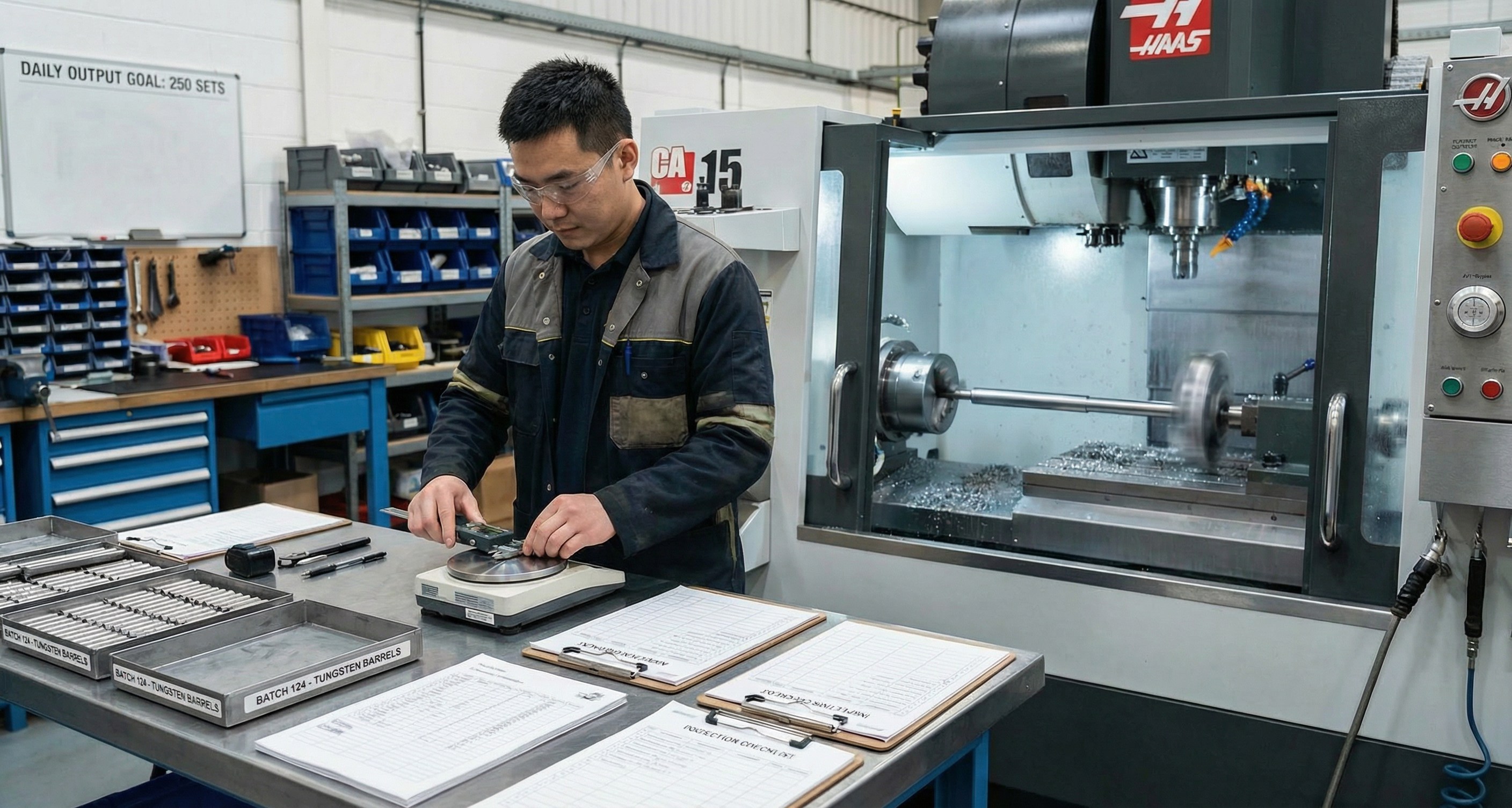
What “In-House Production” Really Means in Dart Manufacturing
In-house production does not simply mean owning a building.
For a professional dart manufacturer, it means direct control over:
-
CNC machining of dart barrels
-
Surface finishing and coating
-
Assembly and set matching
-
Final inspection and packaging
When these steps are outsourced to multiple subcontractors, quality responsibility becomes fragmented.
👉 In practice, this means no single party fully owns the outcome.
Why Outsourced Production Weakens Quality Control
When production is outsourced, QC faces three structural problems:
1. Delayed Feedback Loops
If defects appear:
-
The supplier must contact the subcontractor
-
The subcontractor checks their own process
-
Information returns slowly and often incompletely
By the time action is taken, dozens or hundreds of defective sets may already be produced.
In-house production allows engineers to:
-
Stop machines immediately
-
Adjust parameters in real time
-
Prevent defect expansion
2. Lack of Process Accountability
Outsourced production often leads to:
-
Blame shifting
-
Incomplete records
-
“Within tolerance” arguments
In-house factories assign:
-
Clear responsibility to each process stage
-
Operator-level tracking
-
Machine-specific defect data
This transforms QC from opinion-based to data-driven.
3. Inconsistent Interpretation of Standards
Drawings and specifications are interpreted differently by different workshops.
For darts, small interpretation differences affect:
-
Grip sharpness
-
Balance point
-
Surface friction
In-house teams share:
-
Unified training
-
Shared reference samples
-
Consistent interpretation of tolerances
This reduces subjective variation.
How In-House Production Strengthens Preventive QC
Low-level QC detects problems after they happen.
High-level QC prevents problems before they happen.
In-house dart manufacturers can implement preventive controls such as:
-
Mid-shift weight drift monitoring
-
Tool wear tracking linked to rejection thresholds
-
Coating thickness checks tied to grip performance
Because production and QC are integrated, prevention becomes realistic—not theoretical.
Set-Level Quality Control: A Key Advantage of In-House Production
One of the most overlooked quality factors in darts is set matching.
Outsourced production often checks:
-
Individual dart weight only
In-house production enables:
-
Matching three darts as a functional set
-
Controlling balance feel across the set
-
Rejecting “technically acceptable but practically inconsistent” combinations
This significantly reduces player complaints such as:
“Each dart feels okay, but the set feels wrong.”
Data Collection and Continuous Improvement
In-house factories accumulate long-term data, including:
-
Defect types by process
-
Return-related defect patterns
-
Machine performance over time
-
Operator consistency metrics
This data allows manufacturers to:
-
Identify recurring weak points
-
Improve future production
-
Support stable reorders
Outsourced systems rarely retain or share this level of detail.
Why In-House Control Matters for Reorders and Scaling
Most quality failures occur during scaling, not testing.
When order volume increases:
-
Tool wear accelerates
-
Operator shifts increase
-
Time pressure rises
Factories without in-house control struggle under these conditions.
In-house manufacturers can:
-
Add capacity without losing standards
-
Train operators consistently
-
Maintain batch-to-batch consistency
This is critical for brands planning growth rather than one-off orders.
Cost vs Control: A Common Misunderstanding
Some buyers assume in-house production equals higher cost.
In reality:
-
Returns
-
Rework
-
Lost rankings
-
Brand damage
Cost far more than disciplined internal control.
In-house production often reduces total cost of ownership, even if unit price is slightly higher.
Conclusion
Quality control is not a document.
It is a system built on visibility, speed, and responsibility.
In dart manufacturing, in-house production gives factories the ability to:
-
Prevent defects
-
React instantly
-
Maintain consistency
-
Support long-term reorders
For buyers seeking stable partners, where production happens matters as much as how it is described.
FAQs
1. Is in-house production necessary for all dart products?
For high-precision and reorder-critical SKUs, yes. It significantly reduces risk.
2. Can third-party QC replace in-house control?
No. Third-party QC detects problems but cannot correct them in real time.
3. How can buyers verify in-house production claims?
Ask for process walkthroughs, production photos, and operator-level explanations.
4. Does in-house production improve reorder consistency?
Yes. It enables historical data tracking and process replication.
5. Is in-house manufacturing suitable for large volume orders only?
No. It benefits both small test orders and large-scale production by maintaining discipline.

