

How Dart Pricing Actually Works (Behind the Factory)
Before listing what to provide, it’s important to understand how factories calculate price.
A typical dart quotation is built from:
- Material Cost
- Tungsten percentage (80% / 90% / 95%)
- Raw material price fluctuations
- Machining Cost
- CNC time (complex grips = longer machining)
- Tool wear and replacement
- Surface Treatment Cost
- PVD coating (higher cost)
- Sandblasting / polishing
- Multi-color finishing
- Assembly Cost
- Manual vs semi-automatic assembly
- Component compatibility
- Packaging Cost
- Standard vs custom retail packaging
- Inserts, printing, accessories
- Quality Control Cost
- Inspection level
- Testing requirements
- Logistics & Export Cost
- Packaging size/weight
- Shipping method
👉 This is why incomplete information always leads to inaccurate pricing.
Core Information You Must Provide
1. Detailed Product Specifications (Most Critical)
You should clearly define:
- Weight (e.g., 22g ±0.05g tolerance)
- Material (e.g., 90% tungsten)
- Barrel shape (straight / torpedo / tapered)
- Grip design (ring / shark / knurling / custom pattern)
- Dimensions (length, diameter if available)
💡 Pro Tip:
Even a reference image or competitor link dramatically improves quote accuracy.
2. Customization Scope (Cost Driver)
Clarify exactly what is customized:
- Laser logo engraving
- Colored rings or full coating
- PVD plating (black, gold, rainbow, etc.)
- Custom shafts and flights
- Unique structural design
👉 The difference between “standard + logo” and “fully customized” can change cost by 20–50%.
3. Order Quantity & Forecast
Provide:
- Trial order quantity (e.g., 500 / 1000 sets)
- Expected reorder volume
Factories price based on scale because:
- Setup costs are distributed across units
- Material procurement improves with volume
💡 Example:
1,000 sets vs 5,000 sets can reduce unit cost significantly.
4. Packaging Requirements (Often Underestimated)
Specify clearly:
- Basic packaging (polybag / blister)
- Retail box (paper box / plastic case / magnetic box)
- Custom printing (logo, colors, inserts)
- Accessories included (flights, shafts, tools)
👉 In many OEM projects, packaging accounts for 10%–30% of total cost.
5. Quality Requirements
This is where many buyers fail to communicate.
You should define:
- Weight tolerance (e.g., ±0.05g or ±0.1g)
- Surface finish standard
- Acceptable defect rate (AQL level)
- Inspection requirements
Higher standards = higher cost, but lower risk.
6. Target Market & Sales Channel
Your market determines compliance and positioning:
- Amazon / eCommerce → strong packaging & consistency
- Retail stores → shelf-ready design
- Professional use → higher precision
Factories may adjust:
- Materials
- QC level
- Packaging design
Advanced Information (For Professional Buyers)
If you want even more accurate quotes, include:
- Technical drawings (2D/3D files)
- Pantone color references
- Packaging dielines
- Competitor product samples
- Target price range
👉 This allows suppliers to optimize solutions instead of guessing.
Common Mistakes That Lead to Bad Quotes
Avoid these common issues:
❌ “Same as this picture” (without details)
❌ No quantity provided
❌ No packaging description
❌ Constant spec changes after quotation
❌ Unrealistic target price
These create:
- Delays
- Supplier frustration
- Unreliable pricing
Sample RFQ Template (You Can Copy & Use)
Here is a simple but professional RFQ format:
Weight: 24g ±0.05g
Material: 90% tungsten
Barrel: Straight, ring grip
Customization: Laser logo + black PVD coating
Quantity: 1,000 sets (initial order)
Packaging: Custom paper box with logo, includes flights + shafts
Target Market: Amazon US
Target Price: $X–$X (optional)
Additional: Please include QC standard and lead time
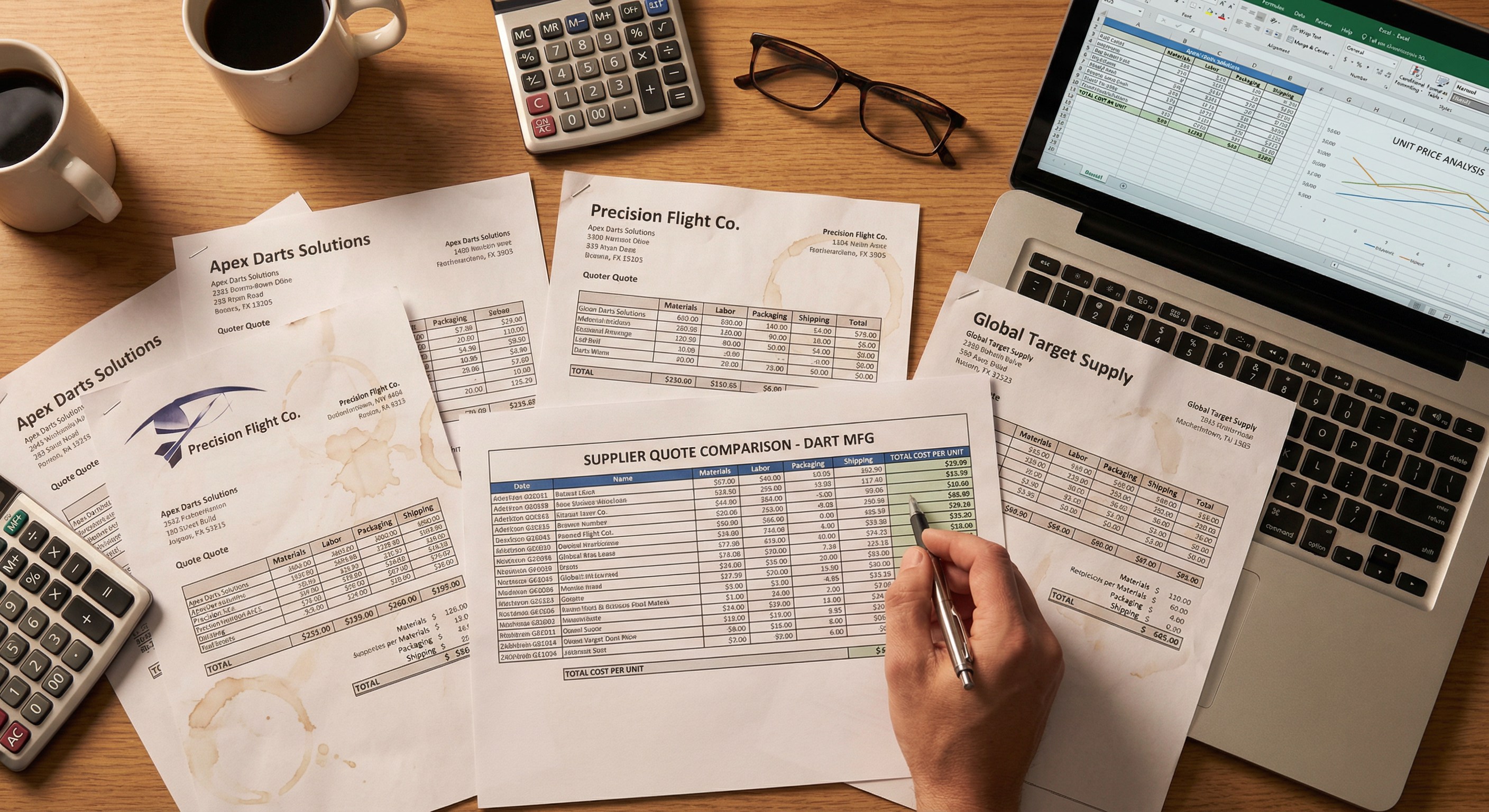
👉 Sending this format can reduce quotation time by 50%+.
How Better RFQs Save You Money
Providing complete information doesn’t just improve accuracy—it can actually reduce cost:
- Fewer revisions = lower development cost
- Faster sampling = quicker market entry
- Better supplier understanding = optimized pricing
Professional communication often leads to better deals, not higher prices.
Conclusion
Getting an accurate dart quotation is not about asking for the lowest price.
It is about providing clear, structured, and complete information so suppliers can respond with:
- Precise pricing
- Realistic timelines
- Reliable production plans
In OEM manufacturing, clarity equals efficiency—and efficiency reduces risk.
FAQs
1. Can I get a final price without detailed specs?
No, only a rough estimate. Final pricing requires full details.
2. What affects dart pricing the most?
Material (tungsten %), customization level, and quantity.
3. Should I provide a target price?
Yes, it helps suppliers align solutions with your budget.
4. How long does a proper quotation take?
Usually 24–72 hours if all information is provided.
5. Can changing specs after quotation affect price?
Yes, even small changes can impact cost and lead time.

