
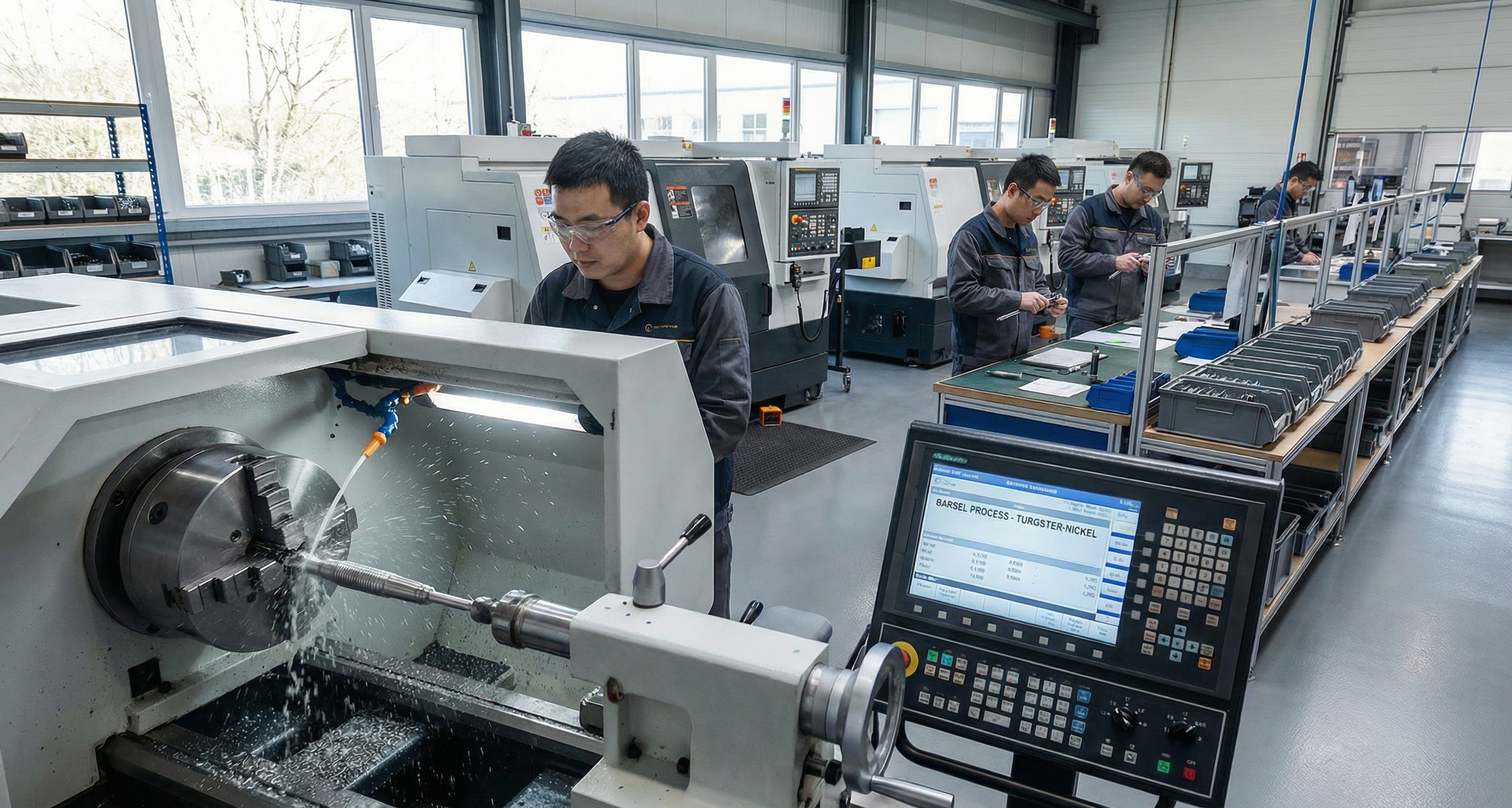
The Real Risk of Scaling Production
When brands move from:
-
500–1,000 sets per month
to -
5,000–20,000 sets per month
several hidden risks emerge.
1. Raw Material Variation
Higher volume often means:
-
Larger tungsten procurement
-
Multiple material batches
If material sourcing is not tightly controlled:
-
Density variations may appear
-
Hardness may slightly shift
-
Machining behavior changes
Even small alloy variations can affect:
-
Center of gravity
-
Impact feel
-
Long-term durability
A long-term supplier maintains:
-
Fixed tungsten grade agreements
-
Material certification tracking
-
Batch-level traceability
2. CNC Program Drift
Scaling production usually requires:
-
Additional machines
-
Additional operators
-
Multi-shift production
Without strict control:
-
Toolpath parameters may be adjusted
-
Cutting speeds may change
-
Tool wear compensation may differ
These micro-changes can cause:
-
Slightly deeper grooves
-
Altered barrel diameter
-
Grip sharpness inconsistency
Professional suppliers lock:
-
CNC programs
-
Tooling specifications
-
Inspection tolerances
Any modification requires engineering approval—not operator discretion.
3. Center of Gravity Consistency
One of the most overlooked scaling risks is balance drift.
Even if:
-
Total weight remains 22g
-
Length remains 50mm
A 0.5mm shift in center of gravity can change throw perception.
Long-term suppliers use:
-
Balance testing fixtures
-
Set-level matching systems
-
Batch comparison charts
They treat balance as a measurable parameter—not a subjective feeling.

Protecting SKU Identity Over Years
Successful dart SKUs often stay in the market for 3–10 years.
Over time, brands may:
-
Increase packaging quality
-
Improve marketing
-
Expand to new countries
But the core product must remain identical.
A professional long-term supplier preserves:
-
Original CAD files
-
First-article inspection reports
-
Historical tolerance records
-
Material sourcing agreements
This ensures that a reorder in Year 4 matches Year 1.
Predictable Scaling Through Process Expansion
Growth does not require redesign.
It requires process expansion.
Instead of changing the product, long-term suppliers adjust:
1. Capacity
-
Add CNC machines of identical specification
-
Duplicate validated processes
2. Quality Frequency
-
Increase sampling rate
-
Add in-line inspection checkpoints
3. Tool Management
-
Standardize tool replacement cycles
-
Monitor wear through usage logs
Scaling becomes structured—not chaotic.
Financial Stability Through Consistency
From a brand perspective, stability reduces:
-
Return rates
-
Negative reviews
-
Customer confusion
-
Re-sampling costs
From a factory perspective, long-term partnership allows:
-
Better production planning
-
Stable material procurement
-
Improved cost forecasting
Both sides gain predictability.
Why Frequent Supplier Switching Destroys SKU Equity
When brands switch factories:
-
Drawings are interpreted differently
-
Minor dimensions are re-optimized
-
Materials may be substituted
Even if specs look identical on paper, execution differs.
The market may notice:
-
“It feels different.”
-
“Grip changed.”
-
“Quality dropped.”
Once SKU reputation is damaged, rebuilding trust is expensive.
The Competitive Advantage of Long-Term Manufacturing Relationships
Long-term suppliers accumulate:
-
Performance data
-
Defect trends
-
Customer feedback insights
This allows:
-
Preventive improvements
-
Cost optimization without quality sacrifice
-
Proactive risk control before scaling
The supplier becomes a technical partner—not just a vendor.
Conclusion
In dart manufacturing, growth is not about constant redesign.
It is about controlled repetition.
A long-term dart supplier protects:
-
Material integrity
-
CNC precision
-
Balance consistency
-
Grip stability
-
Historical accuracy
Scaling should multiply production volume—not multiply risk.
Brands that understand this build durable market positions.
FAQs
1. How can brands verify if a supplier can support long-term scaling?
Request documentation on material traceability, CNC program control, and historical batch records.
2. Is it risky to increase production volume rapidly?
Yes, if capacity expansion is not matched with process duplication and quality reinforcement.
3. Can small dimensional deviations really affect player perception?
Yes. Even sub-millimeter differences in balance or grip can change throw feel.
4. How long should a successful dart SKU remain unchanged?
Many top-performing SKUs stay stable for 3–10 years.
5. What is the biggest mistake brands make during growth?
Chasing lower cost by changing suppliers without evaluating long-term consistency risk.

