
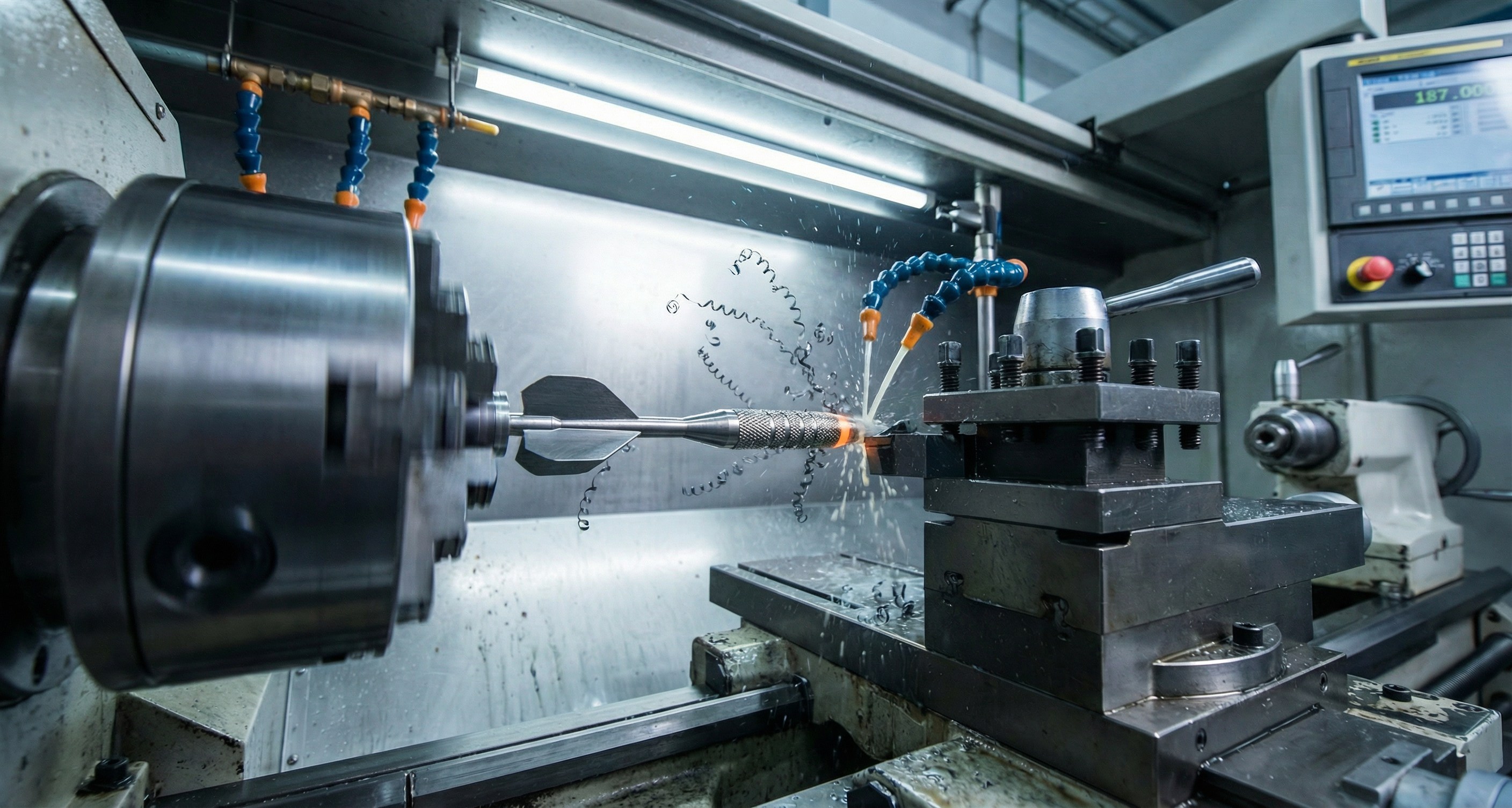
Why CNC Machining Is Essential for Modern Dart Barrels
CNC (Computer Numerical Control) machining allows manufacturers to control every aspect of the machining process through digital programs.
This provides several advantages over traditional machining methods.
1. Extreme Dimensional Accuracy
Dart barrels require very tight tolerances.
Even small dimensional differences can affect:
-
Grip feel
-
Balance distribution
-
Compatibility with shafts and points
CNC machines can maintain precision within microns, ensuring every barrel follows the exact design specifications.
2. Perfect Repeatability
Once a CNC program is created and verified, the same program can produce thousands of identical barrels.
This is extremely important for brands because:
-
Reorders must match previous batches
-
Players expect identical replacement darts
-
Product reputation depends on consistency
Without CNC repeatability, large-scale manufacturing would be unreliable.
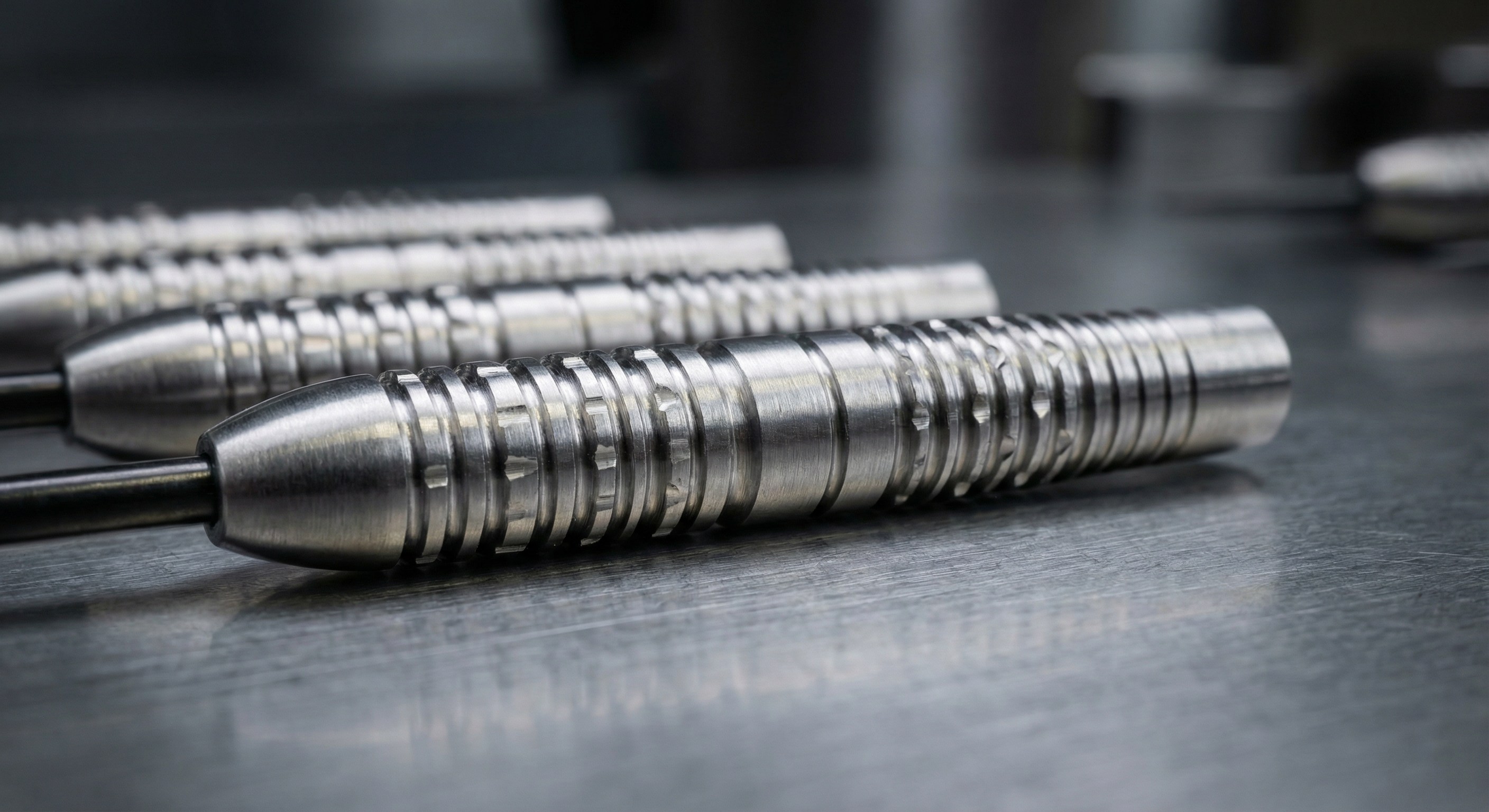
3. Complex Grip Pattern Production
Modern darts feature many advanced grip designs, including:
-
Micro ring grip
-
Shark grip
-
Razor grip
-
Hybrid multi-zone grip
These patterns require extremely precise tool movements and depth control, which CNC machines can achieve consistently.
Manual machining cannot reliably reproduce such complex patterns.
Materials Used in CNC Machined Dart Barrels
The majority of professional dart barrels are made from tungsten alloys.
Typical tungsten percentages include:
-
80% tungsten
-
85% tungsten
-
90% tungsten
-
95% tungsten
Higher tungsten content allows manufacturers to create slimmer barrels while maintaining weight, which many players prefer.
However, tungsten presents machining challenges.
Because tungsten alloys are extremely dense and hard, they cause:
-
Faster tool wear
-
Higher machining resistance
-
Longer processing time
As a result, tungsten barrels require advanced tooling and skilled programming.
Step-by-Step CNC Production Process for Dart Barrels
Although factories may have slight variations, the typical production process includes several stages.
1. Raw Material Preparation
Production begins with tungsten alloy rods cut to approximate barrel length.
Before machining starts, factories usually perform:
-
Material density verification
-
Surface inspection
-
Batch labeling for traceability
This ensures the material meets the required specifications.
2. Rough Machining
During rough machining, the CNC machine removes excess material to create the general barrel shape.
This stage defines:
-
Barrel diameter
-
Initial taper or straight profile
-
Internal drilling for weight control
The goal is to form the base structure before fine detailing begins.
3. Precision Diameter Finishing
Once the rough shape is complete, the machine performs precision finishing.
This step ensures:
-
Exact barrel diameter
-
Smooth surface preparation
-
Uniform geometry across the entire barrel
Precision finishing is critical because even small deviations can change dart balance.
4. Grip Pattern Cutting
Grip patterns are then machined using specialized cutting tools.
Key parameters include:
-
Groove depth
-
Groove spacing
-
Edge sharpness
-
Pattern alignment
Manufacturers must carefully balance grip aggressiveness with comfort.
If grooves are too sharp, players may experience finger fatigue.
If too shallow, grip performance may suffer.
5. Internal Weight Adjustment
Some dart designs require internal adjustments to fine-tune the balance point.
This may involve:
-
Additional internal drilling
-
Micro material removal
-
Structural adjustments
These changes affect how the dart behaves during flight.
6. Surface Finishing Preparation
Before coating or polishing, the barrels go through surface preparation processes such as:
-
Micro polishing
-
Sandblasting
-
Deburring
Proper preparation ensures that later finishing treatments adhere correctly.
Tool Wear and Its Impact on Grip Consistency
One of the biggest challenges in CNC dart machining is tool wear.
As cutting tools wear down over time, they gradually change the shape of the grip grooves.
This can cause:
-
Reduced grip sharpness
-
Slightly shallower grooves
-
Changes in tactile feel
Professional factories manage tool wear by:
-
Tracking machining hours
-
Monitoring grip measurements
-
Replacing tools before tolerance limits are exceeded
Without tool management, later production batches may feel different from earlier ones.
Quality Control in CNC Dart Barrel Production
After machining, barrels undergo multiple inspection stages.
Typical quality control procedures include:
-
Diameter measurement using precision gauges
-
Weight verification with calibrated scales
-
Visual inspection for machining defects
-
Surface consistency checks
Some factories also measure balance point location, which is important for performance consistency.
Only barrels that pass inspection move to the finishing and assembly stages.
Cost Factors in CNC Machined Dart Production
Several factors influence the final manufacturing cost of CNC dart barrels.
1. Tungsten Percentage
Higher tungsten content increases:
-
Raw material cost
-
Tool wear rate
-
Machining difficulty
2. Grip Complexity
More intricate grip designs require:
-
Additional machining time
-
Multiple cutting passes
-
Specialized tools
3. Production Volume
Larger production runs reduce unit cost because:
-
Machine setup costs are spread across more units
-
Tooling efficiency improves
-
Material purchasing becomes more economical
4. Surface Treatments
Additional finishes such as:
-
Titanium coating
-
PVD coloring
-
Laser engraving
increase both production time and cost.
How OEM Brands Work with CNC Dart Manufacturers
For brands developing custom darts, the typical OEM development process includes:
-
Concept design
-
3D modeling of the barrel
-
CNC prototype machining
-
Player testing and feedback
-
Production optimization
Experienced manufacturers often assist brands in refining designs to balance performance, durability, and cost.
Conclusion
CNC machining is the technological backbone of modern dart manufacturing.
It allows factories to produce highly precise, repeatable, and customizable dart barrels that meet the expectations of both casual players and professionals.
For brands sourcing OEM darts, evaluating a manufacturer’s CNC capabilities—including programming expertise, tooling management, and quality control systems—is essential to ensuring long-term product consistency.
FAQs
1. Why are tungsten darts machined with CNC instead of traditional tools?
Because tungsten alloys require extremely precise machining and CNC machines provide the accuracy and repeatability needed.
2. Does CNC machining guarantee identical dart barrels?
CNC allows high repeatability, but proper machine calibration and tool maintenance are also necessary.
3. What tungsten percentage is most common for professional darts?
Many professional darts use 90% or higher tungsten content.
4. How long does it take to machine a single dart barrel?
Depending on complexity, it may take several minutes per barrel.
5. Can CNC machines produce custom grip designs for brands?
Yes, custom grip patterns are one of the biggest advantages of CNC dart machining.

