
What Private Label Actually Means in Dart Manufacturing
In practical terms, private label is closer to ODM-based customization, not full product development.
It typically includes:
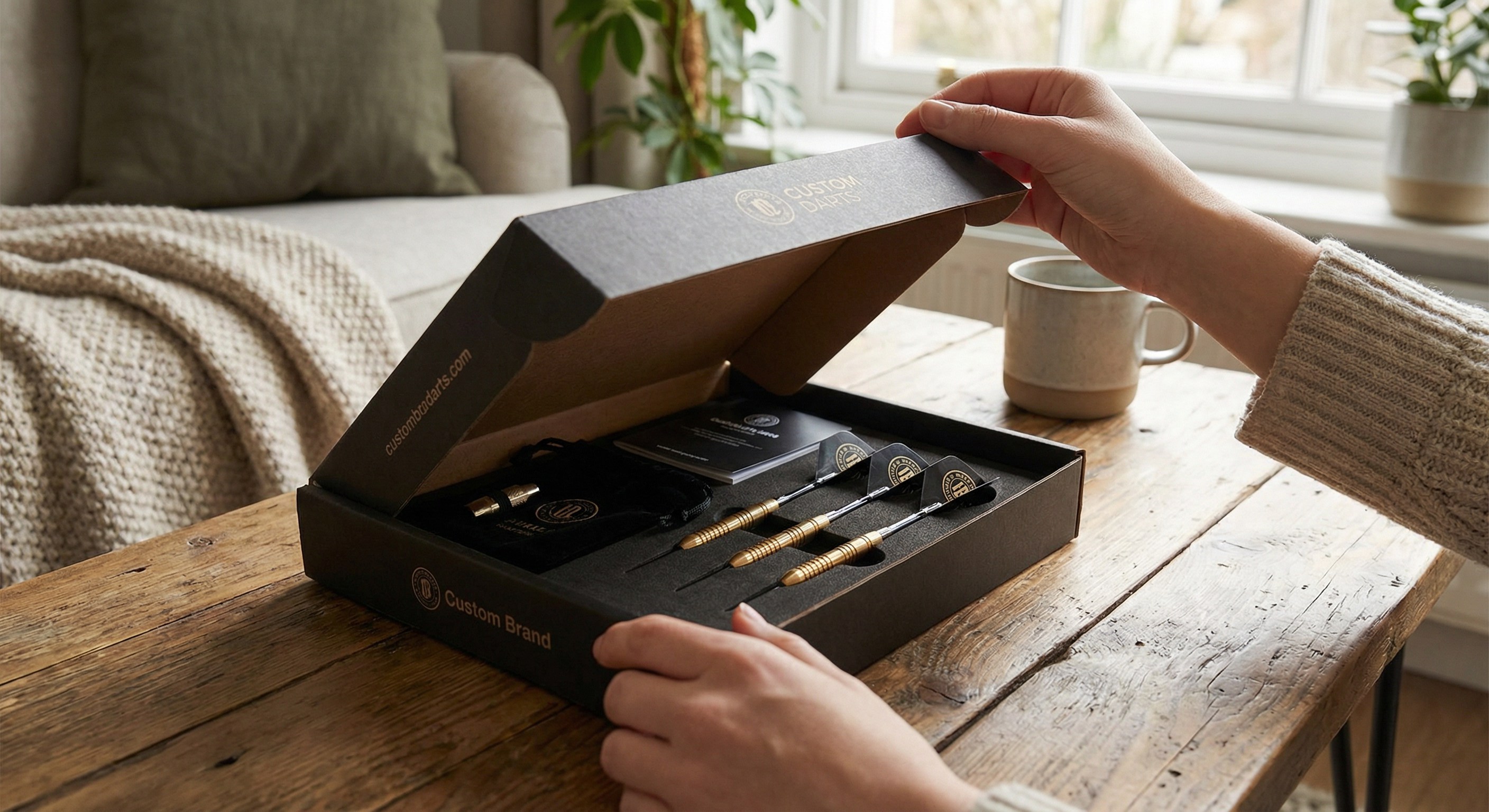
- Logo engraving or printing on barrels
- Custom packaging (boxes, inserts, manuals)
- Color variations (coating, shafts, flights)
- Minor design adjustments (e.g., grip variation within existing tooling)
What it usually does NOT include:
- Completely new barrel structures
- Custom mold/tooling from scratch
- Unique internal weight distribution engineering
The base product is already developed by the factory and tested for production stability.
Why Private Label Is Ideal for Market Entry
Private label reduces several major barriers:
1. Lower Development Risk
You are not investing in unproven designs.
Products already have production history and performance validation.
2. Faster Time to Market
Typical launch timeline:
- Product selection: 3–7 days
- Sample confirmation: 7–10 days
- Production: 20–30 days
This allows brands to move quickly.
3. Lower Minimum Order Quantities (MOQ)
Compared to OEM, private label usually requires smaller MOQs, making it accessible for new sellers.
The Hidden Limitations of Private Label
Despite its advantages, private label has structural limitations:
1. Product Homogeneity
Multiple brands may sell similar or identical products.
2. Limited Technical Differentiation
You cannot fully control:
- Balance engineering
- Barrel geometry innovation
- Proprietary grip structures
3. Price Competition Risk
When products are similar, competition shifts to:
- Pricing
- Marketing
- Branding
This reduces long-term margin potential.
How to Choose the Right Private Label Product
Instead of choosing randomly, focus on:
1. Proven Sales History
Ask manufacturers:
- Which models are best-selling?
- Which SKUs have stable reorders?
2. Balanced Specifications
Avoid extremes. Choose:
- Medium grip styles
- Popular weights (22g–24g)
- Standard barrel shapes
These appeal to wider audiences.
3. Stable Manufacturing Records
Ensure the product has:
- Consistent QC history
- Low defect rates
- Proven durability
Packaging: Your Primary Differentiation Tool
Since the core product is similar, packaging becomes critical.
Effective packaging includes:
- Strong visual branding
- Premium materials
- Clear product information
- Organized internal structure
For Amazon sellers, packaging directly affects:
- Review ratings
- Perceived value
- Customer satisfaction
-

When to Transition from Private Label to OEM
Private label is a starting point—not an endpoint.
You should consider OEM when:
- You have stable monthly sales
- Customer feedback reveals improvement opportunities
- You want to protect your product from competitors
OEM allows you to:
- Customize grip patterns
- Adjust weight distribution
- Create unique SKUs
This builds long-term competitive advantage.
How Manufacturers Support Private Label Clients
Professional dart manufacturers help by:
- Recommending proven products
- Offering packaging design support
- Providing QC documentation
- Ensuring reorder consistency
The best suppliers also guide clients toward OEM when the time is right.
Common Mistakes New Buyers Make
Avoid these frequent errors:
- Choosing products based only on price
- Ignoring packaging quality
- Launching too many SKUs
- Not testing multiple samples
- Expecting OEM-level customization from private label
These mistakes often lead to poor market performance.
Conclusion
Private label darts offer one of the fastest paths to entering the market—but success depends on how strategically you use it.
Treat private label as:
- A testing phase
- A learning process
- A stepping stone toward OEM
Brands that understand this transition build stronger, more defensible businesses.
FAQs
1. Is private label the same as OEM?
No. Private label is usually based on existing designs with limited customization.
2. How much customization is possible?
Typically logos, colors, and packaging—not full structural changes.
3. How long does it take to launch a private label dart product?
Usually 3–5 weeks depending on production and sampling.
4. Can private label products succeed on Amazon?
Yes, especially with strong branding and packaging.
5. When should I move from private label to OEM?
When your sales are stable and you need product differentiation.

