
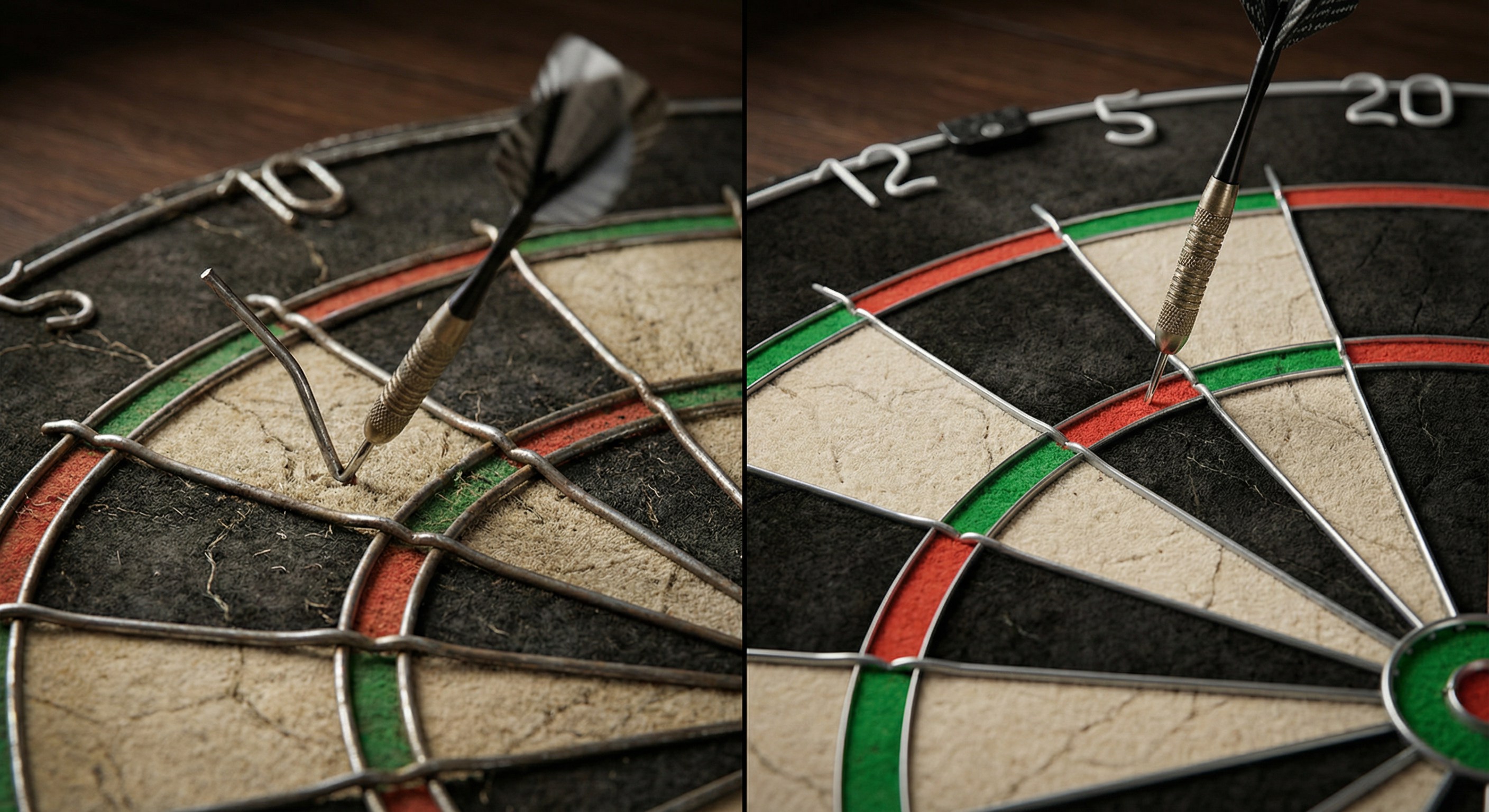
What Is a Bounce-Out in Darts? (Quick Answer)
A bounce-out occurs when a dart hits the board but fails to stick, usually because it:
-
Strikes the wire and deflects
-
Hits a surface that is too hard
-
Cannot penetrate the sisal fibers properly
👉 In modern dartboard design, bounce-outs are reduced through wire engineering, density control, and fiber recovery optimization.
What Causes Bounce-Outs on Dartboards?
Understanding the root causes is essential before evaluating product quality.
1. Wire Impact (Most Common Cause)
-
Dart hits metal wire instead of sisal
-
Deflection sends dart away from board
2. Board Density Imbalance
-
Too hard → dart rebounds
-
Too soft → unstable surface over time
3. Poor Dart Tip Condition
-
Blunt tips reduce penetration
-
Bent tips create unstable entry angles
4. Fiber Degradation Over Time
-
Worn-out boards lose recovery ability
-
Surface becomes uneven
How Blade Wire Technology Reduces Bounce-Outs
One of the biggest innovations in dartboard manufacturing is the shift from round wire to blade wire systems.
Traditional Round Wire (Old Technology)
-
Thick and raised
-
High bounce-out probability
-
Large impact surface
Modern Blade Wire System (Current Standard)
Key features:
-
Ultra-thin flattened profile
-
Angled edges to guide darts inward
-
Embedded deeper into the board
Result:
-
Lower deflection
-
Higher scoring retention
-
Significantly reduced bounce-outs
Staple-Free Bullseye Design
Modern boards eliminate staples in the bullseye area:
-
Removes central bounce points
-
Improves scoring consistency
The Role of Sisal Fiber Density in Bounce-Out Reduction
Most high-quality dartboards use compressed natural sisal fibers.
Why Density Matters
Correct density ensures:
-
Proper dart penetration
-
Reduced rebound force
-
Long-term durability
If the Board Is Too Hard
-
Darts bounce off surface
-
Penetration depth is shallow
If the Board Is Too Soft
-
Fibers separate permanently
-
Surface becomes inconsistent
-
Bounce-outs increase over time
Optimal Manufacturing Balance
Professional dartboard manufacturers control:
-
Compression pressure
-
Fiber alignment
-
Moisture levels
This creates a board that is both:
✔ Durable
✔ Responsive
Why Fiber Recovery Is Critical for Long-Term Performance
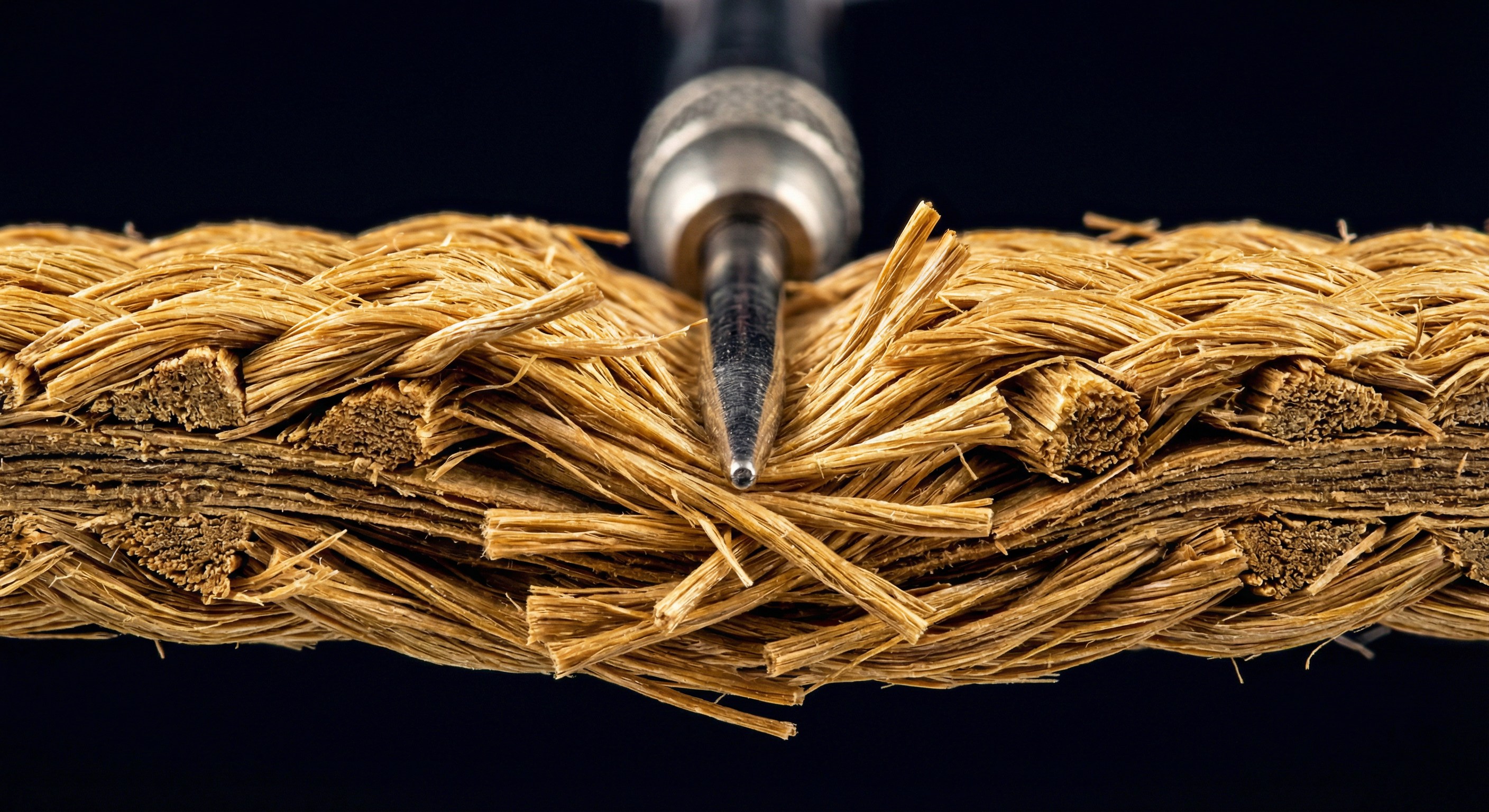
Fiber recovery refers to how well the board closes after dart removal.
High Recovery Boards
-
Close holes quickly
-
Maintain surface integrity
-
Reduce future bounce-outs
Low Recovery Boards
-
Develop permanent holes
-
Create weak zones
-
Increase inconsistency
How Manufacturers Test Fiber Recovery
-
Repeated impact testing
-
Long-session simulations
-
Surface deformation analysis
How Dart Tips Affect Bounce-Out Rates
Even the best dartboard cannot compensate for poor dart tips.
Common Tip Problems
-
Dull tips → poor penetration
-
Bent tips → unstable entry
-
Soft steel → faster wear
Best Practices for Players
-
Regular tip sharpening
-
Use hardened steel points
-
Replace worn tips promptly
Manufacturing Testing Methods Used to Reduce Bounce-Outs
Professional dartboard factories apply structured testing systems:
1. Impact Testing
Simulates repeated throws to evaluate:
-
Penetration
-
Rebound rate
2. Wire Deflection Testing
Tests how darts react when hitting wires:
-
Deflection angle
-
Entry redirection
3. Durability Testing
Long-term usage simulation:
-
Fiber recovery performance
-
Surface wear behavior
Can Bounce-Outs Be Completely Eliminated?
Short answer: No.
Even the best dartboards cannot eliminate bounce-outs completely because:
-
Physics still applies
-
Dart angle varies
-
Player technique differs
👉 However, high-quality dartboards can reduce bounce-outs to a minimal, almost negligible level.
Conclusion: Engineering, Not Luck
Bounce-outs are not random—they are the result of:
-
Wire design
-
Sisal compression
-
Fiber recovery
-
Dart condition
Modern dart manufacturers reduce bounce-outs through precision engineering and continuous testing.
For buyers and brands, understanding these factors is essential when selecting a reliable dartboard supplier.
FAQs (SEO Optimized)
1. What causes bounce-outs in darts?
Wire impact and improper board density are the main causes.
2. Do blade wire dartboards reduce bounce-outs?
Yes, blade wires significantly reduce deflection and improve dart retention.
3. Why do old dartboards have more bounce-outs?
Because fibers degrade and surface hardness becomes inconsistent.
4. Do dart tips affect bounce-outs?
Yes, sharp and straight tips improve penetration and reduce bounce-outs.
5. What is the best dartboard to reduce bounce-outs?
Boards with blade wire systems and balanced sisal density perform best.

