

Dart flights (also called fins) have the greatest impact on the flight trajectory, and according to the “Chinese Dart Referee Rules,” they are an essential component of a dart. Because terminology can be confusing (for example, mistaking “large square flights” for “small square flights”), this guide focuses on key shape classifications and practical rules.
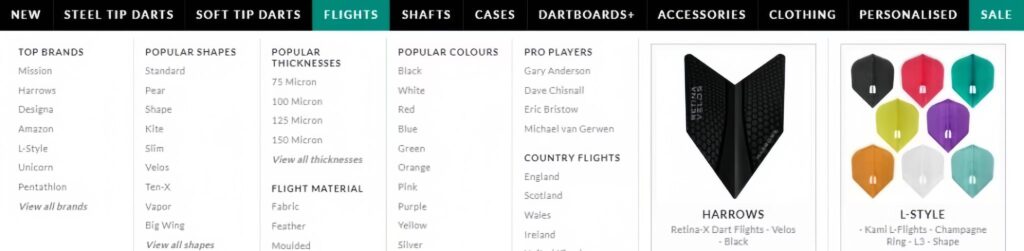
Basic Classification
– Brands: Including EMYTH, One80, CUESOUL, and so on.
– Thickness: 75μm, 100μm, 125μm (popular hard type), 150μm.
– Material: Mostly plastic mixtures; feather and woven fabric flights are rare.
– Important Note: Color, signatures, or national flag patterns do not affect flight performance.
Core Shape Guide (English and Chinese Names and Usage)
1. Large Wing (Large Square Flight):Stable flight; size varies by brand.
2. Shape No6 (Small Square Flight): Versatile; Mini version is smaller (similar to Phil Taylor’s TARGET model).
3. Pear Shape (Large Teardrop):Fast flight speed; used by PDC player Paul Lim.
4. Slim (Narrow Flight):Low drag;
5. Kite Shape (Large Teardrop): Favored by Chinese player Liu Yuanjun.
6. AR1: Gary Anderson’s signature flight; increasingly popular in China.
7. Others: Fan-shaped (once popular in Beijing), V-shaped wings , VELOS (coming soon), and niche models such as Sigma SP (for professional players only, not suitable for beginners).
Verified by professional players: Long stem + Large wing ≈ Medium stem + Shape No6 ≈ Short stem + Pear shape. Use flights of the “same shape, different colors” during matches – avoid changing shapes. Most PDC players use long stems with large wings.

