

We remember the first night at a small league in London: the lights were low, the crowd was quiet, and a single steady throw changed the match.
That moment taught us how a small tweak at the point of release can reshape a player’s confidence and scores. Mastering the way you hold a dart is the first step toward consistent performance.
In this guide, we share clear, professional advice for all players. Whether you play with soft tip or steel tip setups, your grip style and release define the flight and accuracy.
We pair expert tips with tools like the DartCounter App so you can track progress against players around the world. With Free UK Mainland Delivery over £50 and a 4.5 Trustpilot rating, our community supports steady improvement.
Key Takeaways
- Small changes at the release point make big score differences.
- Choose a grip style that fits your body and feels natural.
- Use the DartCounter App to compare practice with players worldwide.
- Test both soft tip and steel tip setups to find your best choice.
- Join a trusted community for feedback and steady progress.
Understanding the Fundamentals of a Dart Grip
Stability at the hand is the silent foundation behind every consistent throw. We build repeatable technique by locking a steady contact and holding a natural posture that feels right for you.
The Importance of Stability
Stability is the cornerstone for every player. A stable contact keeps the barrel aligned through release and reduces random flight errors.
Simple balance between support and relax prevents tension. A standard approach uses the index finger and thumb for support, with the middle finger adding balance.
Finding Your Natural Hold
Every player must test barrel shapes and textures until the fingers sit in a repeatable spot.
- Start with the index and thumb as the main supports.
- Use the middle finger to steady the barrel and maintain balance.
- Try soft tip and steel tip barrels to see what feels consistent.
“Your grip style is a personal choice.” — Professional advice from experienced players
We encourage you to experiment in short practice sessions. Track what feels natural and lock that way into your routine so every throw becomes predictable and strong.
The Mechanics of Holding Your Dart
The mechanics of your hold decide whether throws repeat or scatter under pressure. We focus on simple, repeatable positions that give you control and calm in competition.
Keep it natural. The pencil grip is the most common way players hold dart barrels in instructional videos. It feels like a writing posture and helps with straight releases.
Avoiding Common Finger Positioning Errors
Avoid placing your fingers at a strict 90-degree angle to the barrel. That angle often makes the throw push left or right at the point of release.
Point your index slightly forward to help balance the hand. Many fingers can support the barrel, but the thumb index finger combo is the usual stable option.
“Small tweaks to finger angle win more boards than chasing new equipment.”
| Issue | Cause | Fix |
|---|---|---|
| Side push | Fingers at 90° | Rotate index forward 10–15° |
| Unstable release | Too few contact points | Add ring finger for support |
| Inconsistent aim | Wrong hold style | Use pencil grip trial sessions |
Exploring Common Grip Styles
Players test many holds until one feels like a natural extension of their hand.
Try simple versus complex styles. The pencil grip is a staple for many pros because it promotes a straight release and calm follow-through.
Other players add the ring finger or use many fingers on the barrel to boost control. That extra contact can steady throws but may need practice to keep release consistent.
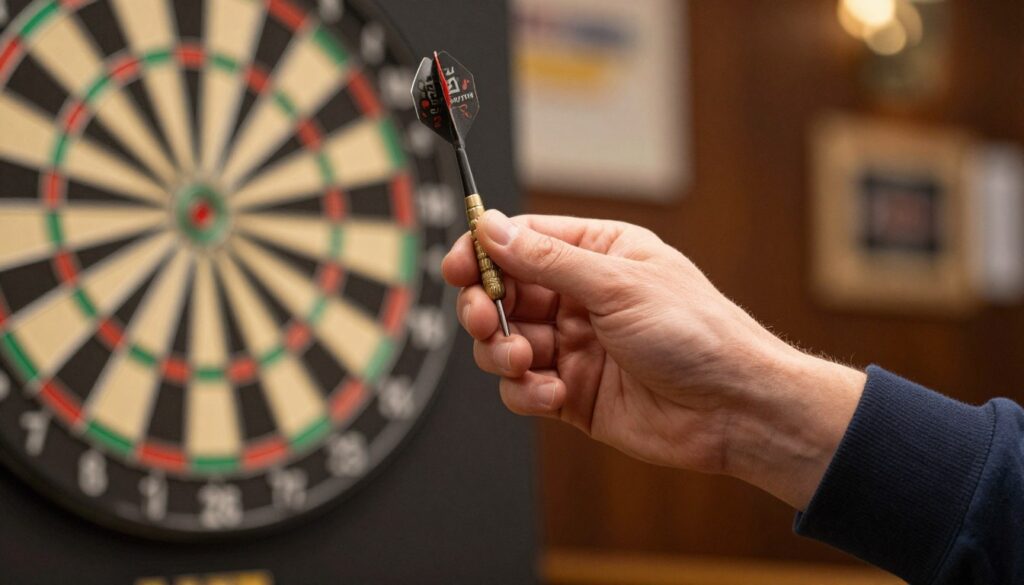
From soft tip to steel tip setups, different barrels and textures change how a hold dart performs. Test both to see what works well with your hand size.
- Minimalist grips: fewer contact points, faster release.
- Multi-finger holds: more control, slower learning curve.
- Thumb-index combos: common and repeatable for many players.
“Legends show the same truth: style varies, but consistency wins.”
Practical tip: Try short sessions focused on thumb, index, and ring placement. Note which grip darts make your scores more repeatable and stick with that choice.
How Barrel Texture Impacts Your Throw
Barrel texture is a tuning dial — it alters contact, timing, and follow-through. The surface you touch sets how your fingers settle and when the release happens.
Smooth and Radial Grooves
Smooth barrels offer a seamless, unobtrusive feel. They suit players who prefer a light contact and fast releases.
Radial grooves give uniformity along the back barrel. That uniformity helps find a consistent release point every throw.
Precision Milled and Pixel Textures
Precision milled cuts create distinct zones for repeatable finger placement. Pixel textures use small diamonds to add traction without abrasion.
These finishes give a confident hold and keep flights steady through the arc.
Nano and Trapezoidal Designs
Nano grip tech uses microscopic texturing to boost stability on both soft tip and steel tip setups.
Trapezoidal and advanced V Stream or Quattro styles deliver balanced contact with deep-cut grooves or four distinct zones. Use them to fine-tune your grip style and the way you hold dart barrels.
| Texture | Feel | Best for |
|---|---|---|
| Smooth | Seamless, fast release | Players who like minimal contact |
| Radial | Uniform alignment | Consistent release point |
| Pixel / Milled | Controlled traction | Repeatable finger placement |
| Nano / Trapezoid | Micro-traction, balanced hold | Stable throws with varied flights |
Tip: Match barrel texture to your natural thumb and ring contacts. Small changes here change scores more than swapping barrels.
Advanced Grip Engineering
Precision-engineered contact zones decide whether your throws feel locked-in or slippery during matches.
We study how barrel design interacts with fingers to raise consistency. Top players use profiles that guide the thumb and index to the same spot every time.
Modern barrels borrow ideas from Phil Taylor’s setups: targeted grooves, ring patterns, and nano-textures that stop slip without forcing a heavy hold.
Whether you prefer a pencil grip or a more technical style, the way the thumb and index meet the metal is critical. Small textural zones on the back barrel change when the release happens and how flights settle.
Match barrel choice to your play. Pick barrels that work well for soft tip or steel tip setups and for your chosen grip style. That match often improves accuracy more than changing technique alone.
“Engineering the contact makes practice transfers to competition.”
- Targeted zones = repeatable contact.
- Ring and nano cuts = secure feel without tension.
- Back barrel texture = subtle flight control.
The Role of Eye Dominance in Accuracy
Eye dominance steers your aim more than most players expect. It affects how you align the throw, where the barrel meets the board, and the repeatability of each release.

Performing the Miles Test
The Miles Test is quick and clear. Make a small triangle with your hands and frame a distant object on the board. Close one eye at a time.
Whichever eye keeps the object centred is your dominant eye. That result shows the best way to line up your stance and follow-through.
- Why it matters: Understanding eye dominance is crucial for players who want better accuracy.
- If you are right-handed but left-eye dominant, your darts may drift left unless you adjust aim.
- Many pro players use this test to match their grip and stance to eye dominance for a consistent game.
- By knowing your dominant eye you can tweak foot position and head angle so each point of contact is aligned.
Tip: Test both eyes, practice small stance shifts, and repeat until alignment feels natural.
Adjusting Your Stance for Better Control
Your body alignment decides whether throws stay straight or start to wander under pressure. Line the shoulder and elbow so they point toward the board, and extend your hand forward as a single plane.
We recommend a relaxed chest and tucked rear foot for stability. This posture keeps your wrist and forearm moving on a consistent track and keeps your grip steady from set-up to release.
Whether you use soft tip or steel tip setups, the same alignment rules apply. Positioning the torso and head so the dominant eye looks directly down the flight helps accuracy.
Throw with a controlled wrist and forearm motion rather than forcing the shoulder. That controlled movement preserves the way the barrel leaves your hand and reduces sideways variance.
Practice drill: Stand, align shoulder-elbow-hand, take five shots focusing only on wrist rhythm. Repeat until the motion feels automatic. With consistent work, your stance becomes second nature and your darts track truer toward the target.
Professional Tips for Consistent Release
A dependable release comes from small, deliberate habits at the hand. We train like that: repeat the same setup, keep tension low, and make release predictable.
Phil Taylor and other pros stress one thing: a repeatable grip style leads to steady scores. Position your index finger and thumb so they control the barrel but do not squeeze.
- Keep fingers relaxed; tense hands change timing.
- Use the back barrel as a reference point to find the most repeatable hold.
- Test both soft tip and steel tip barrels to see what works with your style.
Focus on the point of release. Your eyes, forearm, and hand should move as a single plane. When you practice, aim to replicate the same release motion ten times in a row.
“Small, consistent habits beat big equipment changes.”
We recommend short, focused reps that lock your index and thumb positions. That routine helps every player improve control and accuracy over time.
Conclusion
Improvement starts by pairing the right barrels with a repeatable, calm technique. We urge you to focus on small daily habits that lock a consistent release.
Mastering your dart grip is a journey that needs patience, practice, and honest feedback. Pick barrels that match your hand and refine your grip style in short, focused sessions.
Remember: every top player began with basics. Whether you prefer soft tip or steel tip setups, the goal is the same — a natural, repeatable method that serves your game.
We hope this guide has given you clear, professional tips to raise consistency and enjoy the sport. Keep practicing, track progress, and celebrate steady gains.

