

We still remember the night a local pub match turned into an unforgettable lesson.
One of our players lined up a final throw and the entire room held its breath. The dart hit the right point and a quiet roar followed. That moment showed how gear, aim, and nerves shape every outcome.
Today, professional darts has grown beyond pubs into global arenas. We invite you to explore rules, key equipment, and the tournament scene that define modern play.
Whether you favor dardos com ponta de aço or the accessible soft tip darts, understanding the tip and shaft is the first step. We will cover the steel construction, tip darts choices, and how the low price of entry belies the intense practice needed to compete.
Pontos-chave
- We break down rules and gear so you can master the board quickly.
- Choice between steel tip and soft tip affects feel and tournament play.
- Technique and point control matter more than high-price equipment.
- Players benefit from consistent practice and gear that matches style.
- We guide you on price versus performance to pick the right setup.
Understanding the World of Professional Darts
What began as a British pastime in 1908 has morphed into a global competitive spectacle. In 1908 the game was declared a game of skill in the United Kingdom, and that recognition set a long arc of growth.
We trace modern structure to the PDC, formed on 16 January 1992, which helped turn local leagues into televised tours. Today, top players draw huge audiences and sponsorships, lifting british darts into a multi-million dollar industry.
The stakes rise with every match. The competitive field makes the price of failure steep, so players refine technique and mental focus daily. Many top players start in clubs and work up the ladder to the circuit.
| Marco | Year | Impact |
|---|---|---|
| Skill recognition | 1908 | Legitimized the game in British law and culture |
| PDC founded | 1992 | Created a unified pro tour and global exposure |
| Commercial growth | 1990s–present | Higher prize money, sponsorship, and broadcast deals |
Essential Equipment for Every Player
We know gear shapes results. A well-matched set gives players control from the grip to the tip.
Steel Tip Choices
Modern steel tip options must meet strict limits: no more than 50 grams total and 300mm length. Choose barrels with a textured grip to help consistency during long sessions.
Soft Tip Options
Soft tip darts suit electronic boards and many home setups. They offer safer play and different balance, so players often test both types to find what fits their throw.
- Weight and feel: darts grams affect flight and release.
- Material: darts steel or tungsten mixes change durability and price.
- Maintenance: keep tip and barrel in good condition for accuracy.
| Feature | Steel Tip | Soft Tip |
|---|---|---|
| Typical Use | Club and tournament play | Electronic boards & home |
| Max Weight | Up to 50 grams | Up to 50 grams |
| Grip Focus | Barrel texture and grooves | Balance and shaft length |
| Price Range | Mid to high (precision machining) | Low to mid (safer tips) |
Anatomy of a Quality Dartboard
A true competition board starts with materials that shrug off wear and keep scores honest.
The regulation board is 451mm in diameter and built to last. Top models use sisal fibers sourced from Eastern Africa, Brazil, and China. This material lets the board self-heal so hits close to the wire do not ruin the surface.
Choose a good dartboard to make each point count during practice. A quality board helps steel tip darts penetrate cleanly and reduces bounce-outs. The board’s grip on the tip improves consistency and protects your set.
- Durability: Sisal fibers help the surface last longer and keep scoring true.
- Accuracy: A well-made board registers impacts reliably so your practice pays off.
- Setup: Mount at the correct height to preserve form and protect the board.
- Value: The price of a higher-grade model is worth it for sustained play and fewer repairs.
Design has stayed steady for decades: 20 numbered sections, a stable bull, and consistent wiring. Invest in the right board and your throws will improve faster.
Choosing the Right Dart Barrel Material
Choosing the barrel material changes how you hold, aim, and score. We focus on common options so you can pick the best fit for your play and budget.

Tungsten Advantages
Tungsten darts are dense—about twice the density of brass—so the barrel can be much thinner for the same mass.
This allows a tighter grouping on the board and a more consistent release. Tungsten barrels often offer a superior grip and a compact profile that helps scoring.
Brass Trade-offs
Brass darts are a budget-friendly choice. They cost less but typically have a larger diameter for the same darts grams.
Larger barrels can make tight trebles harder to hit. For casual play or beginners, brass is a sensible starting point while you refine aim.
Nickel Silver Options
Nickel silver sits between brass and tungsten in feel and price. It gives different balance and grip options for players testing weight and profile.
- Key choice: material affects barrel diameter, grip, and consistency.
- Performance vs price: tungsten costs more but often lasts longer and improves tight grouping.
- Try before you buy: test shapes and weights measured in grams to see what suits your release.
The Importance of Shafts and Flights
Small swaps to shafts or flights change your release more than you expect. The shaft and flight are the aerodynamic pair that keep a dart steady and land it at the right angle.
Experiment with shaft lengths to find a balance for your set. Short shafts tighten grouping; longer shafts add stability for slower throws. Try one change at a time and note how your grip and release react.
The flight shape controls drag. Wide flights slow the dart and suit slower arm speeds. Slim flights cut through the air for faster releases. Many players swap flights mid-match to nudge trajectory.
Maintenance is simple and inexpensive. Replacing worn shafts or bent flights costs little but preserves consistent darts grams and a reliable grip. That low price makes customization easy and effective.
- Choice: match shaft length to your throw style.
- Grip: a steady hold improves release consistency.
- Tip care: keep the tip and shaft threads clean to avoid wobble.
Mastering the Oche and Throwing Distance
The oche is where intent meets measurement — a fixed line that tests every throw. We train here to make release and aim repeatable under pressure.
Standardized Throwing Dimensions
Key measurements: the front of the oche sits 2.37m from the board face. The bullseye center is 1.73m from the floor. These dimensions are standard for competition and for serious practice.
Stance and hold: we teach players to adopt a stable stance, maintain a steady grip, and hold dart with a relaxed wrist. A consistent grip and balance keep the point of the dart true on release.
Respect the line. Stepping over the oche is a foul and costs shots. The price of top-level play is hours at this exact distance, repeating throws until muscle memory locks in.
- Practice tip: rehearse at 2.37m with game-speed throws.
- Fine-tune: check grams and feel of your set; small changes affect trajectory.
Scoring Systems and Game Mechanics
Scoring boils down to split-second math and steady aim—every point reshapes the path to victory.
The basics: three darts can score up to 180, while the highest finish with three darts is 170. In standard 501 play, players start at 501 and count down to zero.
Matches often require a finish on a double. That rule raises the pressure on the final throw.
“The percentage of successful checkouts is a key metric in evaluating players during a tournament.”
- Hitting the triple 20 is the fastest route to big scores and shortens the road to a finish.
- Every point counts; quick math helps plan the next three-dart set.
- A missed double can cost the match, so mental control is as valuable as physical skill.
| Metric | Value | Why it matters |
|---|---|---|
| Max three-dart score | 180 | Shows scoring ceiling for aggressive play |
| Max three-dart finish | 170 | Common sight in tight matches |
| Checkout percentage | Match-dependent | Key performance indicator for tournament players |
Master the math behind your score and the point of impact on the board becomes your focus. That clarity turns pressure into routine and improves percentage of successful finishes.
Professional Darts Corporation History
Sixteen elite players walked away in 1992 and sparked a new era for professional darts. They left the British Darts Organisation to seek better pay, clearer tournament paths, and more media exposure.
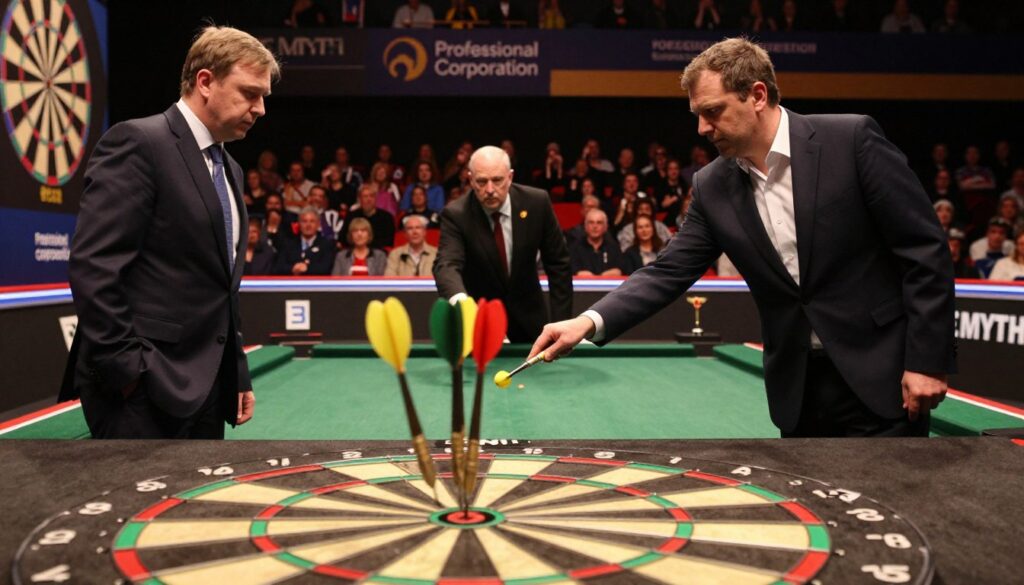
That split reshaped british darts and created a competitive circuit aimed at top players. Phil Taylor emerged as a central figure, lifting the profile of the breakaway tour.
The Split from the BDO
The decision to split was about choice and growth. The founders wanted larger prize pools and stronger event control for players.
The Tomlin Order
The Tomlin Order of 1997 settled the legal fight and reopened options. After that ruling, players could compete across more events and the sport stabilized.
“The price of the legal battle was high, but it paved the way for the modern era of play.”
- Impact: clearer tournament structure and bigger purses.
- Legacy: van barneveld became a world champion under the new banner.
- Result: a pro circuit that rewards top players and attracts global audiences.
| Year | Event | Outcome |
|---|---|---|
| 1992 | Founding of PDC | New circuit led by 16 players |
| 1997 | Tomlin Order | Legal settlement; expanded player choice |
| 1990s–2000s | Rise of Stars | Phil Taylor & van barneveld boost global appeal |
Major Tournaments on the Circuit
The calendar of elite tournaments defines the rhythm for top players across the year.
The PDC World Darts Championship stands as the crown event. It draws global attention and the biggest prize pools. Phil Taylor’s 14 titles set a benchmark that still influences every champion’s legacy.
Other marquee events include the World Matchplay and the UK Open. These tests force consistency over days, not just one great set. Emerging stars like Luke Littler and Luke Humphries now push established names such as Michael van Gerwen and Raymond van Barneveld.
The German Darts Grand Prix has grown into a major European stop. It combines high crowds, ranking points, and strong local support. Every event on the circuit awards points crucial for World Championship qualification.
“Winning a big event demands focus, stamina, and perfect timing.”
| Event | Why it matters | Notable names |
|---|---|---|
| PDC World Championship | Highest prestige and prize pool | Phil Taylor, Michael van Gerwen |
| World Matchplay | High-pressure legs, legacy value | Raymond van Barneveld, Gerwyn Price |
| German Darts Grand Prix | Key European ranking event | Top players from Europe and beyond |
Iconic Players Who Shaped the Sport
Great players change a game’s rules in the minds of fans long after a match ends.
Legends of the Game
Phil Taylor sits at the top with sixteen world champion titles. His consistency set a new standard for pressure play and match tempo.
Raymond van Barneveld won five world titles and brought dramatic comebacks to center stage. Those finishes helped expand the sport’s global reach.
More recent stars reshaped style. Michael van Gerwen introduced an aggressive scoring pace that rivals now study. Young talents like Luke Littler and Luke Humphries press that edge in every tournament, forcing top players to adapt.
Their stories include different paths: the rise of Gerwyn Price from other sports, and Beau Greaves breaking barriers in the women’s game. Each name proves the price of greatness is steady work and mental grit.
“Iconic players make every tournament a lesson in skill and will.”
- Legends shaped rules of play and public interest.
- Top names drive growth of the darts circuit and inspire new talent.
Television Coverage and Broadcast Innovations
From tight close-ups to board-embedded lenses, live coverage turned single throws into shared moments.
Sky Sports led the charge with flight cams and cameras built into the board. These tools let fans follow each dart in slow motion and study entry angles.
High Definition broadcasts arrived in 2008 and raised expectations. Later experiments with 3D and augmented graphics made a match feel immersive at home.
Why it matters: multi-camera setups capture player reactions, close-ups of the oche, and instant replays. That production value turns a tournament into an event.
Sets in televised matches add structure and extra tension. Viewers see momentum shift as players fight to claim each segment.
“The visual upgrades and expert commentary bring nuance to every throw.”
- Commentators explain strategy to new and seasoned fans.
- Walk-on music and TV profiles turn players into household names.
- The high price of broadcast tech has paid off in audience growth and sponsorship.
The Evolution of Player Nicknames and Image
What used to be a quiet pub entrance now opens with song, smoke, and a name the crowd chants. This shift helped turn simple matches into branded moments that fans remember.
Nicknames build story. Eric Bristow earned the tag “The Crafty Cockney”, and Phil Taylor took on “The Power” after the Snap! song. Those names made them icons and made their entrances part of the show.
We see how the PDC used persona and spectacle to sell events. Walk-on music, pyrotechnics, and tailored shirts create a cue for the crowd. The image upgrade helped attract younger and more diverse fans.
- Every nickname reflects personality, origin, or style on the oche.
- Players who invest in image often recoup the cost in fans and endorsements.
- Stagecraft raises the entertainment value and the overall price of creating a brand.
“A great nickname turns a player into a story the audience follows.”
Regional Variations and Alternative Games
Regional formats add new layers of skill, forcing players to rethink aim and timing. Local rule tweaks create fresh challenges and keep practice sharp.
American Variants
American play survives in pockets of Pennsylvania and New Jersey. Local leagues use unique scoring and board setups that reward quick adaptation.
Many leagues use soft tip darts on electronic boards, so players who train on steel tip darts often adjust balance and release when they switch.
Cricket
Cricket asks you to control numbers 20 down to 15 and the bull. It is a race to open and own sections rather than a countdown to zero.
That shift changes strategy: focus on specific targets and guard them from opponents. The game sharpens accuracy and tactical thinking.
- Why try variants: low price of entry and rapid skill gains.
- Transferable skills: aim, rhythm, and consistency help across formats.
- Global notes: german darts scenes embrace both classic and alternative play.
Conclusion
At its core, the game asks for steady aim, clear planning, and calm focus under lights. We celebrate a sport that blends mental grit with physical precision and constant innovation.
strong, legends like Michael van Gerwen and Raymond van Barneveld reshaped expectations, while rising stars such as Luke Littler remind us that the field keeps evolving.
We covered essential gear, the PDC story, and the tournament map that frames modern play. Whether you are a casual fan or an aspiring player, the scene offers clear paths to improve and compete.
Join the community, train with purpose, and keep tracking great matches—players worldwide are raising the bar every season.

