
Edit
Full screen
Delete
Basic Darts Rules
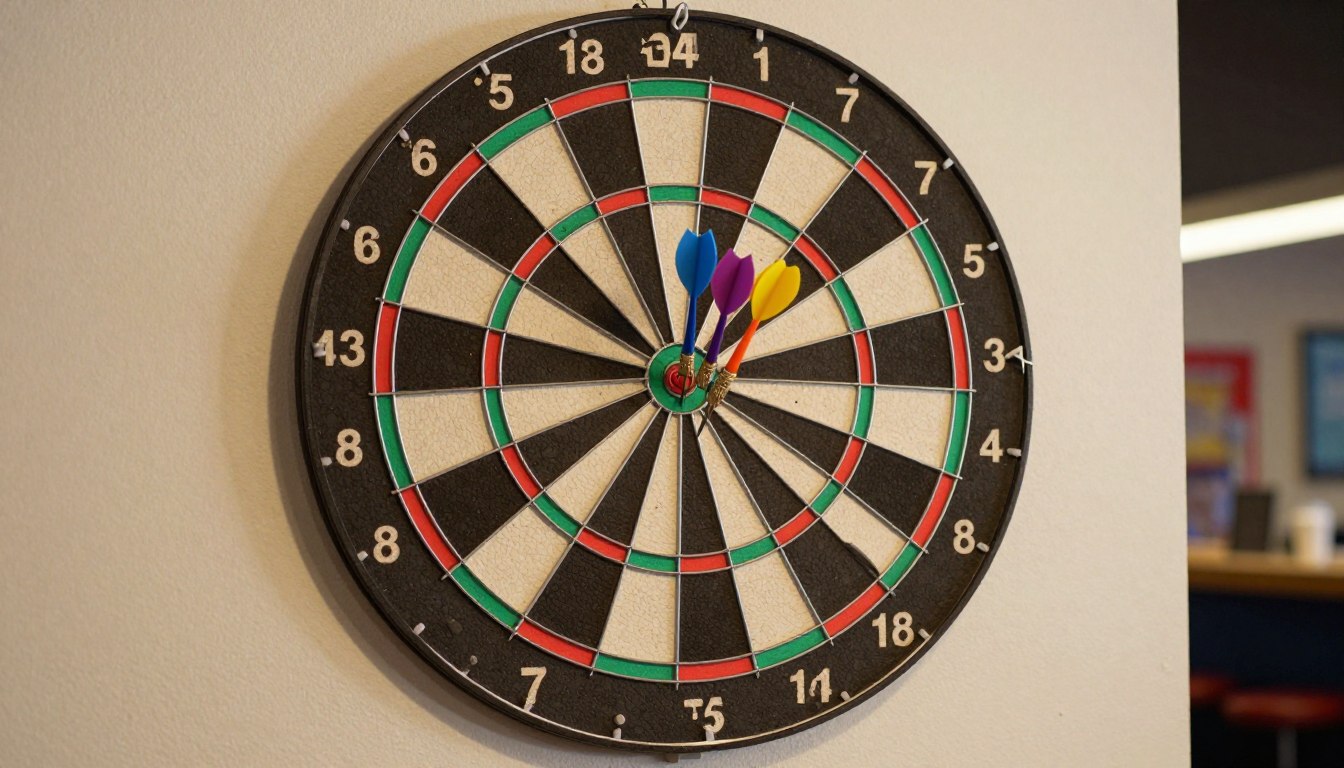
The standard dartboard is divided into twenty numbered segments, each with its own face value. The board also includes a triple (treble) ring and a double ring that multiply a segment’s value, plus an outer bull (25) and an inner bull (50). Understanding this layout is the first step to scoring well and building reliable strategy.
“Darts is 90 percent mental, and the other half is physical.”
Quick roadmap: first learn the board and how points are scored, then set up your board and oche correctly, and finally practice targeted drills to improve consistency. This guide will walk you through each step.
To make the scoring concrete: a single 20 scores 20 points; the triple 20 (often written T20) scores 60 points; and a double 20 scores 40. The inner bull is worth 50 (counted as double 25), the outer bull 25. Remember these basics when you throw three darts per turn during most games.
| Target ZonePoint ValueStrategic Importance | ||
| Single Segment | Face Value (e.g., 20) | Consistency and setup |
| Double Ring | Double value (e.g., D20 = 40) | Closing the game / finishing |
| Triple Ring | Triple value (e.g., T20 = 60) | High scoring potential |
| Outer Bullseye | 25 Points | Mid-range accuracy |
| Inner Bullseye | 50 Points | Maximum precision / finish |
Summary for screen readers: the table above maps target zones (single, double ring, triple ring, outer bull, inner bull) to their point values and strategic role.
Next: set up your dartboard and measure the oche correctly to match tournament standards — see “Essential Equipment for Your Setup” below. Practice visualizing common scoring outcomes (for example: two triple 20s and a single 19 = 139 points) so you become comfortable calculating remaining points under pressure.
Essential Equipment for Your Setup
Your performance starts with the right equipment. Quality dart equipment—from the board you mount to the darts you throw—affects consistency and confidence. Choose gear that matches your style, and you’ll notice steadier grouping and a more repeatable release.
Selecting the Right Dartboard
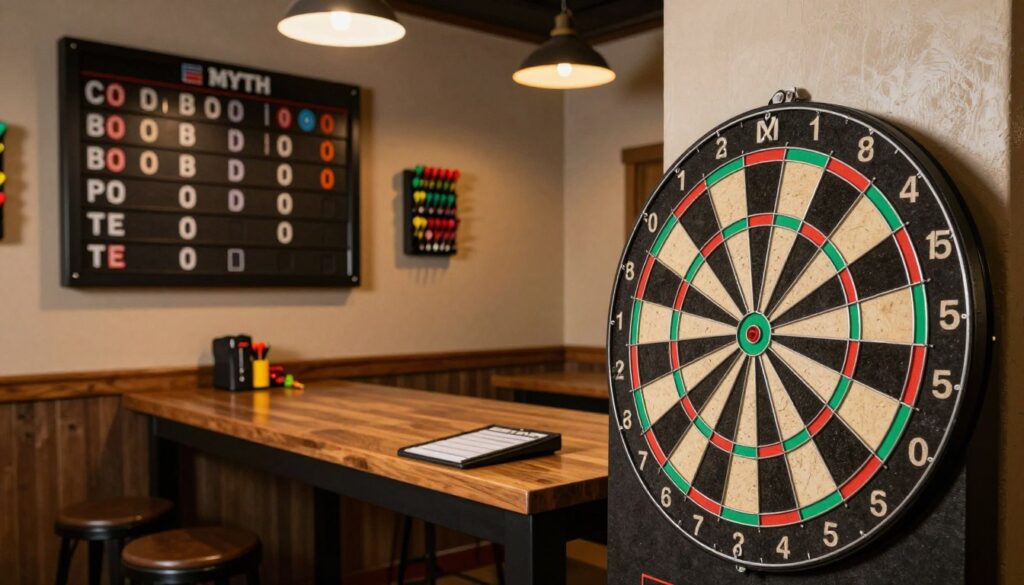
For most players, a professional-grade bristle dartboard made from sisal fibers is the best choice. Sisal boards self-heal over time and tolerate heavy use far better than cheap alternatives. Look for a high-density board with a slim wire or staple-free spider to reduce bounce-outs and maximize scoring potential.
Quick buying checklist: bristle dartboard, surround/backboard to protect your wall, a reliable oche marker (tape or rubber strip), and a scorekeeping board or app.
Choosing Your Dart Weight and Grip
Barrel weight and grip are personal but follow some practical ranges: beginners typically do well with 20–26 grams; many intermediate and pro players experiment above or below that range to find their sweet spot. Try a few sets with different barrel shapes (straight, tapered, or torpedo) and grip textures (knurled, ringed, smooth) until your release feels consistent.
Practical tip: test 3–5 throws with each weight and note where your groupings land. If your throws tend to fall low, consider a slightly heavier barrel; if they fly high, try a lighter option.
Setting Up the Oche and Throwing Distance
Accurate setup helps build tournament-ready muscle memory. The regulation distance from the face of the board (the bullseye plane) to the front of the oche (throw line) is 7 feet 9.25 inches. Measure from the board’s surface—not the surrounding frame—when you mark your oche.
If you don’t have a fixed oche, use strong tape on the floor for a temporary line or a rubber oche strip for a permanent solution. On carpeted floors, place a thin plywood or rubber mat under the oche to stabilize footing.
| Key FeatureBenefit | ||
| Bristle Board | Sisal Fiber | Self-healing surface; durable for repeated play |
| High Density | Slimmer profile / thin wiring | Fewer bounce-outs; better scoring |
| Aerodynamic Shape | Well-balanced darts | Stable flight path |
| Oche Line | Regulation Distance (7′ 9.25″) | Tournament consistency |
Safety & protection: install a backboard or surround to protect your wall from missed throws, and consider a floor mat to protect both your floor and your feet.
How to measure quickly: place the board at regulation height (center of bull at 5 feet 8 inches from the floor in most standards), then measure 7 feet 9.25 inches from the face of the board straight out to mark your oche. If you need a reference, many governing bodies (WDF/PDC) list the standard measurements—link to authoritative sources in your final draft.
Next step: once your dartboard setup and oche are in place, move to the “Proper Stance and Throwing Technique” section to align your body and throwing mechanics with the equipment. For gear recommendations or to purchase professional-grade equipment, see our E MYTH contact and shop section.
Mastering the Basic Darts Rules for 501
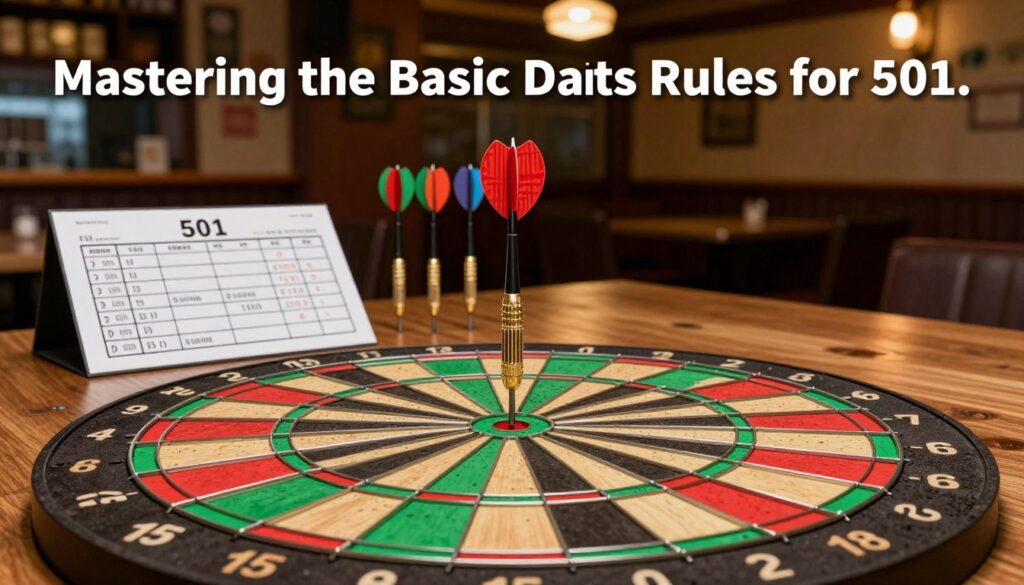
Stepping up to the oche for a game of 501 brings the competitive side of darts into focus. This format is the gold standard in tournament play and rewards both tactical precision and quick mental calculation. Learn these core rules and you’ll be able to manage pressure and finish matches with purpose.
Quick rules checklist
1) Each player starts with 501 points. 2) On your turn you throw three darts. 3) Subtract the total points scored from your running total. 4) To win, you must reach exactly zero and your final dart must land in a double segment or the inner bull (50).
Starting the Game and Scoring
Every player begins with 501 points. On each visit to the oche you throw three darts and subtract the combined value from your score. Accurate scoring keeps you in contention; mistakes in arithmetic cost chances to win.
If your turn reduces your score below zero, or leaves you with exactly one point, it’s a “bust.” A bust ends your turn immediately and your score reverts to what it was at the start of that turn.
Understanding the Double-Out Requirement
The finish is where matches are decided. The double-out requirement means your last dart must land in a double segment (including the inner bull counted as double 25 = 50). Some leagues have variations (double-in or straight in), so confirm the house or tournament rules before you play.
Because of double-out, your strategy must include planning leaves—positions you aim to leave yourself that are straightforward to check out. For example, leaving 40 (single 20 then double 10) is a common goal because it’s a one-dart double finish if you hit a single 20 first.
Common Checkouts and Examples
Practice the standard checkout routes so they become second nature. A few useful examples:
- 170: T20, T20, Bull (maximum three-dart finish)
- 100: T20, D20 (two-dart finish)
- 40: D20 (single-dart finish if you have one dart left)
- 32: D16 (common double to aim for)
Example scenario: you have 121 remaining. A common route is T20 (60) → 11 (11) → D25 (bull as double 25) to finish 121 in three darts. Practice these combinations so you can calculate and adapt mid-game.
Calculating Remaining Scores Efficiently
Quick mental math is an essential skill. Constantly track your remaining total and the best checkout combinations. Work on pattern recognition (e.g., which leftover numbers lead to common doubles) so you can plan two or three moves ahead rather than just throwing at the highest-scoring area.
Suggested drill: “40 checkout practice” — start a session by repeatedly trying to finish from 40; aim to hit D20 five times in a row. This builds confidence in predictable finishes and reinforces the habit of aiming for practical doubles rather than always chasing trebles.
Next: connect this scoring practice to your physical routine in the “Proper Stance and Throwing Technique” section to turn those planned checkouts into reliable throws.
Step-by-Step Guide to Playing Cricket
Cricket is a tactical, control-focused darts game that complements the high-scoring race of 501. Instead of racing to zero, you compete to “close” specific targets while managing a running point total. Mastering the cricket darts rules will sharpen both your scoring and defensive instincts.
Targeting the Numbers 15 Through 20
Cricket centers on the numbers 15 through 20 and the bullseye. Each of those targets must be hit three times to be considered “open” for scoring: a single counts as one hit, a double as two, and a triple as three. Focus on the higher numbers first (20s, then 19s) to build scoring leverage early in the game.
Beginner opening sequence suggestion: prioritize 20 → 20 → 19 on your first visits to establish a lead; this gives you the best chance to score heavily before your opponent catches up.
Closing Numbers and Scoring Points
Once you have hit a number three times, subsequent hits on that number add to your running points total—provided your opponent hasn’t also closed that number. If both players have closed a number, it is removed from play for scoring purposes.
How to win Cricket: close all required numbers (15–20 and the bull) and finish with an equal or higher point total than your opponent. For example, if you’ve opened 20 and your opponent hasn’t, a triple 20 adds 60 points to your score and increases the pressure on them.
Strategic Defensive Play
Cricket rewards smart defense. If your opponent is scoring on a number you haven’t opened, prioritize closing that number rather than chasing additional points. Closing their scoring avenues denies them points and shifts momentum in your favor.
Quick defensive checklist:
- Monitor which numbers each player has opened.
- Close numbers your opponent is scoring on before piling on points elsewhere.
- When ahead on points, switch to closing remaining numbers to secure the match.
Cricket is as much about timing and board control as it is about raw accuracy. Practice closing drills (e.g., repeatedly open and close 20s and 19s in a timed session) to improve the split-second decisions that win games.
Want tactical practice? Move on to the “Advanced Tips for Improving Your Game” section to find drills and routines focused on closing, scoring management, and mental resilience.
Proper Stance and Throwing Technique
Your consistency on the oche starts with a reliable dart stance. A repeatable, stable position reduces variables in your throw so your muscles can do the same motion every time. Small adjustments to stance and release deliver big improvements in grouping and scoring.
Establishing a Consistent Stance
Step-by-step stance setup:
- Foot placement: place your lead foot so it points toward the board; many prefer an angle between 45° and 90° relative to the board—choose what feels natural and repeatable.
- Weight distribution: keep about 60% of your weight on the lead foot and the rest on the rear foot to avoid swaying.
- Body alignment: square your shoulders to the target plane without twisting your torso; keep your head steady and eyes focused on the intended .
Once you find a comfortable stance, mark it (use tape on the oche or note a visual cue). A marked spot builds consistent muscle memory each time you step up.
The Mechanics of the Throwing Motion
Your throwing motion should be a controlled, repeatable sequence: shoulder -> elbow -> forearm -> hand. Common coaching guidance is to keep the upper arm relatively still and use your forearm as a pendulum to provide a smooth path to the release.
Key technique tips:
- Grip: hold the so the barrel sits comfortably in your fingers — light pressure prevents tension.
- Backswing: use a short, consistent backswing; avoid over-accelerating.
- Release: aim for a single, smooth release point rather than snapping your wrist unpredictably.
Practice drill: 30 throws focusing only on a smooth, identical release—ignore score and note where darts land.
Following Through for Accuracy
Follow-through matters. After release, continue the arm motion towards the board as if you were reaching to shake the target’s hand. This keeps your forearm on plane and reduces late movement that causes misses.
Simple follow-through drill: throw 10 darts while consciously extending your arm to the same endpoint each time. Track how your grouping tightens.
Troubleshooting Common Misses
Short checklist if your darts consistently miss:
- Always left: check your stance and aim point; move feet slightly right or adjust sightline.
- Always right: mirror the above—confirm grip and release timing.
- Landing low: try a slightly heavier or adjust release angle; heavier barrels often help stabilize flight.
- High grouping: consider a lighter barrel or flattening your release angle.
| Stance TypeBody AngleWhen to Use | ||
| Front-Facing | 0 Degrees | Beginner comfort; easier balance |
| Side-On | 90 Degrees | Stable for precision players |
| Angled | 45 Degrees | Popular balance of stability and aiming |
Cross-reference: pair stance work with your equipment choices—dart weight and grip (see Equipment section)—so your mechanics and your gear complement each other. Regular practice with focused drills (release, follow-through, and grouping) will steadily improve your accuracy and scoring.
Etiquette and Sportsmanship on the Oche
Darts is as much a social sport as it is a test of skill. Good and courteous behavior keep matches enjoyable for everyone—whether you’re playing casually at a pub or competing in a local tournament. Follow basic etiquette to show respect for your fellow and to preserve the integrity of the game.
Respecting Your Opponent
When an opponent is at the oche, remain quiet and still. Even small distractions can break concentration. A simple nod, smile, or handshake before and after a match goes a long way toward building a positive atmosphere.
Polite phrases to use:
- “Good luck” or “Nice throw” before/after turns.
- “Let’s check the score” to calmly confirm a close tally.
- “Referee, please” if a formal decision is needed.
“The true measure of a competitor is not just in the points they score, but in the grace they show when the pressure is at its highest.”
Maintaining Pace of Play
Keeping a steady rhythm helps everyone enjoy the match. Avoid unnecessary delays between throws and be ready when it’s your turn. Slow play can ruin a match’s flow—respect the and order of play.
| ActionProfessional ApproachDisruptive Behavior | ||
| During Opponent’s Turn | Stand quietly behind the oche | Talking, moving across the line |
| Pace of Play | Keep matches moving; be ready | Frequent stalling or long breaks |
| Match Conclusion | Congratulate the winner | Arguing about luck or equipment |
Handling Disputes: A Simple Process
If a scoring dispute or foul occurs, follow these steps to de-escalate and resolve the issue fairly:
- Stop play immediately and keep players calm.
- Confirm the last recorded score with the opponent and marker.
- If unclear, call a neutral third party or referee for a ruling.
- Accept the official decision and resume play in good faith.
Maintaining clear, respectful communication preserves the spirit of the sport and prevents small errors from becoming big arguments.
Do / Don’t Quick List
- Do: Keep silence while others are throwing; offer a polite handshake at the end of the match.
- Do: Be ready when it’s your turn to keep the game moving.
- Don’t: Pace or distract in the opponent’s line of sight.
- Don’t: Argue loudly about calls—use a referee when necessary.
Joining a league or attending a tournament is a great way to experience formal rules darts play and to practice good etiquette under competitive conditions. Respectful players help the sport grow—be one of them.
Common Fouls and Scoring Disputes
Even in casual games, unexpected situations happen. Knowing the standard protocols for fouls and score disagreements keeps matches fair and lets players focus on performance. Keep calm, follow the rules, and resolve issues quickly so the game can continue.
Handling Bounce-Outs and Dropped Darts
One of the most common frustrations is a bounce-out: the dart strikes the board but does not stick and falls to the floor. In nearly all official darts rules, a dart that does not remain in the board scores zero points.
Similarly, if a dart slips from your hand before release or falls off the board after landing, it usually counts as a dead dart (no score). You cannot re-throw a dart that has bounced out—accept the result, reset your focus, and continue with your remaining darts.
Preventing Bounce-Outs (Quick Tips)
- Use thin wiring or a board with a staple-free spider to reduce deflections.
- Check and replace worn flights—nylon or poly flights can stabilize flight and reduce bounce-outs.
- Match dart point type and weight to your board and throwing style; small adjustments can reduce bounce frequency.
- Ensure the board is mounted at the correct height and is not loose or warped.
Resolving Disagreements During Match Play
Score disputes are best solved with a calm, step-by-step approach. Follow this simple flow:
- Stop play immediately—do not continue throwing.
- Confirm the last recorded scores with your opponent and the marker (if present).
- If the discrepancy remains unresolved, pause the match and call a neutral third party or referee for a final decision.
- Accept the official ruling and resume play in good faith.
Sample dialogue to de-escalate: “Let’s pause—can we check the last score together?” or “I think this dart bounced out; can we confirm the marker’s record?” Politeness speeds resolution and keeps the focus on the game.
“True sportsmanship is found in the ability to respect the game and your opponent, even when the outcome is not in your favor.”
Bottom line: follow the established , communicate clearly, and use a referee when necessary. These simple practices protect the integrity of your match and ensure all enjoy a fair competition. For additional practice, work on equipment checks and drills that minimize bounce-outs and improve consistency.
Promoting the Sport with E MYTH
At , we see darts as more than a pastime — it’s a global community built around precision, competition, and continuous improvement. Our focus is practical: provide quality gear, training resources, and connection points so players at every level can improve and enjoy the game.
The Mission of E MYTH in Darts
Our mission is to supply professional-grade equipment and actionable support that helps you perform better on the oche. Whether you’re a casual player or aiming for tournament play, we deliver products and guidance designed to improve accuracy and consistency.
How to Get Involved in the Community
Join the emythdarts network to access practical benefits that support growth and competition:
- Discounts on pro-level and accessories.
- Access to training drills, video guides, and practice plans.
- Invites to local events and opportunities to connect with other players and teams preparing for tournaments.
Contacting E MYTH for Support and Inquiries
If you need help choosing gear or want advice on practice routines, our team is ready to assist. Typical response time is 24–48 hours for messages. We respect your privacy and will only use contact details to respond to your inquiry.
You can reach us through the following channel:
- WhatsApp: Click here to chat with us
Ready to upgrade your setup or join a training session? Contact us to learn about current offers and events — let help you take your game to the next level.
Advanced Tips for Improving Your Game
If you want to move from casual play to serious competition, you need a structured plan. Competitive improvement in combines targeted practice, data-driven analysis, and mental preparation. The following tips and routines give you a practical roadmap to raise your scoring average and perform better in tournament play.
Developing a Practice Routine
A consistent dart practice routine is the backbone of every top player. Structure sessions so each one has a clear goal: warm-up, scoring drills, finishing practice, and a short review. Example weekly template:
- 3 sessions per week, 45 minutes each.
- Session split: 10-minute warm-up (grouping drills), 25 minutes scoring/checkouts, 10 minutes finishing and mental focus.
- Record one key metric each session (average score per three darts, number of successful checkouts, or bull accuracy).
Three specific drills to add to your routine:
- Checkout Practice (20 minutes): Start from common finishes—40, 32, 80, 121—and aim to finish within three darts. Repeat each finish 10 times.
- Grouping Drill (10–15 minutes): Aim for the triple 20 for 50 throws, tracking how many land in the triple ring to measure accuracy and consistency.
- Mental Routine (5–10 minutes): Practice visualization—see your ideal throw and finish before you step to the oche; combine with breathing exercises to manage pressure.
Analyzing Your Throwing Patterns
Recording and reviewing sessions accelerates progress. Use your phone to video a set of throws or log scores in a spreadsheet. Look for repeatable patterns: are your misses mostly left, right, high, or low? That pattern tells you whether to adjust stance, grip, or release.
Data-driven actions:
- If misses trend left, check your stance alignment and sightline.
- If you miss low, consider a slightly heavier or a flatter release angle.
- Track long-term trends (weekly averages) to see the effect of equipment or technique changes.
Mental Preparation for Competitive Play
Mindset separates good players from great ones. Practice staying calm under pressure by simulating match scenarios in practice: put a scoring penalty on misses, or play timed legs against yourself. Use visualization and a consistent pre-throw routine to maintain focus.
Pressure drill: play best-of-5 legs where you start each leg with a small handicap (e.g., opponent has 40 points lead) to practice comeback resilience.
| Training FocusActionExpected Outcome | ||
| Routine Building | Structured sessions, measurable goals | Higher scoring average |
| Pattern Analysis | Video + score logging | Reduced grouping errors |
| Mental Conditioning | Visualization + pressure drills | Improved match performance |
Equipment and Practice Synergy
Match your practice to your gear. If you’ve chosen a heavier or lighter set of darts (see equipment recommendations), spend a week of dedicated throws to let muscle memory adapt before making technical changes. Consistent practice with the same equipment (same flights, shafts, and weight) is critical to reliable performance.
Weekly Progress Check
At the end of each week, review your numbers: three-dart average, checkout percentage, and target hit rate (e.g., triple 20 %). Small, measurable improvements compound—aim for 1–3% gains per week in a focused metric.
Final Checklist Before Tournament Play
- Verify board and oche setup (center of bull at regulation height; oche at standard distance).
- Use the same darts, flights, and shaft combinations you practiced with.
- Perform your mental warm-up and visualization routine prior to stepping to the oche.
- Plan simple checkout routes for common leaves (e.g., 72 → T16 D12, 40 → D20).
We hope these advanced tips help you structure your improvement and prepare for competitive matches. For more drills, downloadable practice plans, or to upgrade your gear, reach out to E MYTH through our contact channels—let us support your journey from recreational player to serious competitor.

